

 By Gusto Guitar
One volume and one tone offer shared control; two of each can provide pickup-specific settings. The count is only a starting point—verify the assignments and how the controls interact.
Comparing 1V1T vs 2V2T guitar controls requires the actual circuit and control interactions to be understood, rather than only counting knobs. A compact layout may make a quick overall adjustment easy, while separate controls may let you prepare contrasting pickup settings. Neither arrangement guarantees a particular sound or a more professional guitar. The useful choice depends on the control map, circuit behaviour and movements required during your own music.
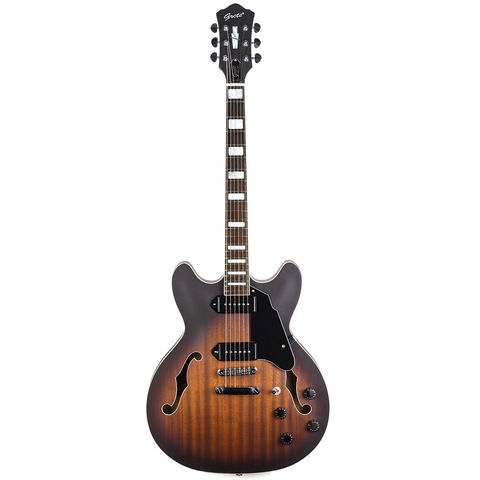
Gusto Guitar GT335-04 reference image. Confirm the current knob assignments and wiring; the number and placement of knobs are not a complete circuit description.
Map the functions of 1V1T vs 2V2T guitar controls
V denotes volume and T denotes tone in this shorthand. A 1V1T description identifies one volume and one tone control; 2V2T identifies two of each. It does not identify every extra switch, selector or function built into a push-pull knob.
A volume control changes the signal level, while a conventional passive tone control changes the tonal balance by reducing high-frequency content as it is turned down. Confirm the actual circuit if the guitar has active electronics or other special functions rather than applying that description automatically.
The pickup selector is another part of the operating map. Two guitars with the same number of knobs can offer different pickup combinations, and one knob may perform an additional switching function. Ask for the complete layout rather than decoding only the letters.
A shared-control example and a separate-control example
The official Ibanez RG7421 control description identifies a volume knob, a tone knob and a five-way selector. It is a useful example of how a manufacturer can explain the physical layout and switching system separately.
Gibson’s Les Paul Standard 50s specification lists two volumes, two tones and a three-way selector. These are model-specific examples, not rules that every similar body style must follow.
For your own order, ask which pickup or signal path each control governs. Do not copy the knob positions from another model or assume that controls nearest the neck always serve the neck pickup. An annotated diagram is easier to use than an ambiguous sentence.
What shared volume and tone controls make convenient
With a shared layout, you can often make an overall adjustment without deciding which pickup-specific knob to use. If you switch pickup positions frequently and want the same broad volume setting to follow you, that may suit the task.
The trade-off is that you cannot assume separate stored knob settings for each pickup. If the bridge and neck positions need different volume or tone adjustments for your song, you may need to move the shared control as well as the selector. Test that sequence rather than treating fewer knobs as automatically easier.
Also evaluate whether the physical position supports the technique you use. A master volume that is easy to reach for swells may be placed where another player occasionally touches it unintentionally. The useful answer comes from playing, not from a diagram alone.
What two volumes and two tones can offer
A conventional pickup-specific arrangement can let you prepare one pickup for accompaniment and another for a contrasting part. For example, you might set the neck position for one passage and the bridge position for another, then change with the selector.
Try this at the volume and gain you intend to use. A lower guitar-volume setting can change the response of a driven signal chain as well as the final listening level. Judge whether the prepared transition produces the musical result you want rather than assuming the numbered knob settings describe exact output percentages.
Separate controls may also let you shape a combined-pickup sound. However, that combined mode is where circuit interactions become especially important. Do not assume it behaves like a perfectly independent two-channel mixer.
Understand the combined-position interaction
Gibson’s Dusk Tiger manual discussion of classic Les Paul wiring describes an interaction in which turning either volume fully down can silence the combined setting. It is a documented example of why two volume controls need not be independent in every operating condition.
This does not establish the behaviour of every four-knob guitar. Alternative wiring arrangements exist, and the actual instrument must be checked. Ask what should happen when one volume is at zero with both pickups selected before interpreting that result as a fault.
For a useful test, begin with both volumes up, select the combined position and reduce one control gradually. Restore it, then test the other. Record the result and compare it with the maker’s intended operation. Avoid changing multiple controls at once during this diagnostic step.
Use the same musical transition to compare layouts
| Playing task | 1V1T question | 2V2T question |
|---|---|---|
| Overall level change | Is the shared volume easy to reach and control? | Which control must move in the selected position? |
| Prepared contrast | Can the required settings be reached quickly enough? | Can separate pickup settings simplify the transition? |
| Combined pickups | What combination does the selector provide? | How do the volume and tone controls interact? |
| Tone adjustment | Does one shared setting suit the useful pickup positions? | Are separate settings useful rather than distracting? |
| Extra functions | Does a knob also switch another circuit? | Are added switch functions clearly assigned and documented? |
Evaluate the sweep, not just the endpoints
Turn a volume control through its range while repeating a phrase. Notice where the useful change happens and whether it is easy to reproduce. The printed number halfway around the knob should not be treated as a universal statement that the output is half its maximum.
Do the same with the tone control. Find the range that preserves the articulation you need, then repeat the passage with accompaniment. A useful adjustment may be much smaller than the difference between fully open and fully closed.
If two sample guitars behave differently, ask about the complete circuit before blaming the number of controls. Component choices and wiring can differ within either layout. The count of knobs does not specify the response of their sweeps.
Separate a volume change from a gain change in the demonstration
Start with a clear amplifier setting to hear how the guitar controls operate. Then repeat with your intended driven sound. Rolling the guitar down may change how the rest of the signal chain responds, so the musical result should be tested with the actual rig.
Keep automatic level correction and editing out of the control demonstration where practical. You need to hear the transition, including any level step, rather than only isolated clips adjusted to sound equally impressive.
For remote approval, request one continuous passage showing the hand movements and naming the pickup position. That makes the comparison more useful than a description claiming many tones without showing how they are reached.
Build a control map for the player and the technician
A player-facing map should label the knobs as seen in the playing position and identify any push-pull or other switch action. It should also describe the selector direction. A technician-facing record should include the actual diagram and component information needed for service.
Do not assume that two visually identical replacement controls have the same specification or physical fit. Have a proposed repair assessed against the actual model. If a supplier changes the circuit, update both the service record and the public operating description.
Related reading: pickup configurations explained. Pickup layout and control layout are separate parts of the same operating system.
Which layout suits your hands and set?
Choose a shared layout when its useful settings and simple overall adjustments fit your playing. Choose separate controls when prepared pickup-specific sounds or combined-position shaping provide a practical benefit. Neither choice is automatically more versatile in the situations that matter to you.
Does 2V2T always mean independent volumes?
No. Verify combined-position behaviour on the actual circuit and compare it with the maker’s documentation.
Does 1V1T mean only two available sounds?
No. The selector and any additional switching determine the available connections. Knob count is not a count of sounds.
Can a four-knob guitar be simpler in a performance?
It can be, if separate preset settings reduce the movements needed during a song. Rehearse the actual transition before deciding.
Explore Gusto Guitar’s solid-body guitars and semi-hollow range, then request the exact control map for the configuration you intend to order.

Get Best Guitars
Join Gustoguitar.com Newsletter to get more information of electric guitars, classical guitars, and all kinds of guitars.


