

 By Gusto Guitar
A practical guide to body construction, feedback, playing comfort and a fair side-by-side test—before you choose a guitar or approve a wholesale sample.
Choosing between a solid body and a semi-hollow electric guitar is easier when you start with the job the instrument must do. A guitarist playing beside a loud drummer has different priorities from someone recording clean parts at home. A dealer selecting a first product range must also consider setup consistency, packing and the questions customers will ask after delivery.
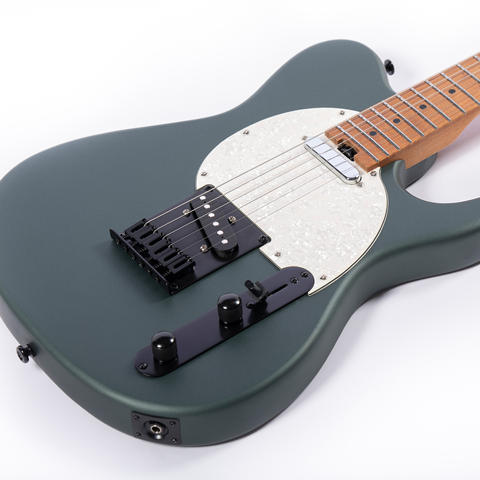
A solid body electric guitar example from Gusto Guitar. Confirm each model’s current specification before ordering.
The body label gives you useful information, but it cannot settle the entire purchase. Two guitars with different pickups, scale lengths and setups are not a controlled test of body construction. This guide separates the structural differences from the checks you should make on the actual instruments.
1. What actually changes inside the body?
Solid body: a largely solid structure with functional cavities
A solid-body electric guitar normally has a largely solid body with routed spaces for pickups, electronics and hardware. “Solid body” does not necessarily mean one piece of timber: bodies can be assembled from several pieces. The term also should not be confused with a solid-wood top, which describes a different aspect of construction.
Semi-hollow: hollow areas combined with structural support
A common semi-hollow arrangement has hollow side chambers and a solid central section supporting the bridge and pickups. Construction varies, so an f-hole alone is not a complete specification. Ask whether there is a center block, where it runs, and how the bridge is mounted. Yamaha’s electric guitar family guide illustrates the distinction between solid, semi-acoustic and hollow instruments.
A fully hollow guitar is a third category. Do not treat “hollow,” “semi-hollow,” “chambered” and “jazz guitar” as interchangeable labels in an enquiry. One describes a broad construction, another may describe a musical use, and a supplier may use the terms inconsistently. Request a construction description alongside the model number.
2. Compare the practical trade-offs
| Question | Solid body | Semi-hollow | What to verify |
|---|---|---|---|
| Will I use substantial stage volume or gain? | A sensible starting point when feedback resistance is a priority. | Test at the intended volume rather than judging from a quiet demonstration. | Actual amplifier settings, speaker position and feedback behaviour. |
| Will the guitar feel comfortable? | Depends on body shape, contours, balance and the particular instrument. | Depends on body dimensions, balance and the particular instrument. | Seated and standing comfort, measured weight and upper-fret access. |
| Will it cover my preferred sounds? | Evaluate the complete pickup and control configuration. | Evaluate the complete pickup and control configuration. | Matched-volume clean and driven recordings. |
| Will servicing be straightforward? | Inspect access to the controls and output jack. | Inspect how the electronics can be reached and replaced. | Access openings, component mounting and service instructions. |
| Which costs less? | No reliable answer from the body label alone. | No reliable answer from the body label alone. | Like-for-like specification and the complete delivered quotation. |
This table is a decision framework, not a ranking. A compact solid body with uncomfortable edges can be a worse choice for a particular player than a larger semi-hollow that sits well. Likewise, an inexpensive instrument that needs substantial setup work may be less economical than its initial quotation suggests.
3. Understand feedback without turning it into a genre rule
Feedback occurs when the amplified sound feeds back into the instrument and the loop becomes self-sustaining. Hollow construction can make this behaviour more relevant in amplified use. Yamaha notes that semi-acoustic designs are more prone to feedback than solid bodies in its electric guitar anatomy overview. That is a reason to test the intended rig, not proof that a semi-hollow cannot be used outside jazz.
During a comparison, record what you can observe. Does an unwanted note begin only when you face the speaker? Does moving to your normal stage position help? Does it occur on one pickup setting or across several? These observations are more useful than an unqualified statement that one construction “handles distortion” and the other does not.
Begin at a moderate volume, then approach the level you actually expect to use. Stop if the sound becomes uncomfortably loud. Do not create an extreme demonstration simply to force a result: the point is to find the instrument’s useful operating range for your situation.
4. How to conduct a fair side-by-side test
Step 1: write down the differences you are not testing
Before listening, note the pickup type, pickup position, string set, scale length, bridge and current setup. If these differ, your conclusion applies to the two complete guitars. It does not isolate the effect of the body. This distinction prevents a common purchasing mistake: attributing every audible difference to the most visible specification.
Step 2: use a repeatable playing sequence
Choose a short sequence that represents your playing: an open chord, a chord higher on the neck, a bass-string phrase, a single-note line and a sustained bend if you use bends. Repeat it on the same pickup setting, with the same amplifier and effects. Keep the performance simple enough that changes in playing do not dominate the comparison.
Step 3: match listening level before judging character
A louder example can seem more impressive even when it is not better suited to the job. Make a second comparison at a similar listening level. Keep both recordings: the original level shows the practical output difference, while the adjusted version helps you concentrate on the character you prefer.
Step 4: include comfort and serviceability in the result
Play seated and standing. Check whether the neck stays where you expect when you relax your fretting hand, whether your picking arm rests comfortably, and whether the controls are reachable without accidental changes. Photograph the electronics access and bridge arrangement. A purchase decision should survive a long rehearsal and a future repair, not just a short sound clip.
5. Three common buying situations
A first electric guitar for mixed styles
Start with a comfortable instrument that is well set up and supported by clear specifications. A solid body can be a practical shortlist choice, but a well-fitting semi-hollow is not automatically unsuitable for a beginner. Compare tuning behaviour, fret condition and access to a teacher or technician before spending extra for a particular appearance.
A player moving between home recording and live work
Make two tests rather than averaging the environments together. First record the parts you need at home. Then evaluate the same guitar in a rehearsal arrangement close to the live situation. If the instrument excels at one job but creates a specific compromise in the other, decide whether that compromise matters often enough to justify a second guitar.
A dealer building a small initial range
Define a role for each model: a straightforward first electric, a stage-focused option, or a different construction and playing experience. Avoid stocking several cosmetic variations before you know which customer need each one serves. Use the same acceptance checklist across samples so body type does not distract from inconsistent fretwork, hardware or documentation.
6. What to request before approving a sample
- Construction: body material, solid or laminated sections, chamber layout and center-block description where applicable.
- Dimensions: actual sample weight, body thickness and overall dimensions—not a generic range copied from another model.
- Playing specification: scale length, fret count, neck measurements and the supplied string gauge.
- Electronics: pickup configuration, control layout and a clear explanation of the selector positions.
- Service access: photographs showing access to pots, switches and the output jack.
- Acceptance record: dated photos, a short repeatable sound demonstration and an agreed list of acceptable cosmetic variations.
If the title and specification sheet disagree, pause approval until the supplier confirms the exact sample. A model name is not a substitute for a revision-controlled specification. Keep the confirmed document with the order so later substitutions can be discussed against the same reference.
7. Questions buyers often ask
Is a semi-hollow always lighter?
Do not assume so. Compare the measured weight of the actual instruments and consider balance as well as total weight. The body dimensions, timber, structural parts and hardware can differ between models.
Can a solid body be used for jazz?
Choose by the sound and response you need, rather than treating a construction label as a permission rule. Include a clean comparison using the pickup and control settings you expect to play.
Can I practise on a semi-hollow without an amplifier?
You can assess the physical fit while it is unplugged, but do not use that as the main test of its amplified performance. If your aim is an acoustic practice instrument, compare the actual unamplified level and intended use rather than relying on the word “hollow.”
Should I choose by body type or pickups first?
Shortlist by your working conditions and physical preferences, then compare complete pickup configurations. If two otherwise suitable guitars differ substantially in both areas, try them as complete instruments instead of pretending the comparison isolates one variable.
Choose with a written priority list
List your three most important requirements before comparing finishes: for example, rehearsal-volume behaviour, standing comfort and a specific clean sound. Reject a sample only for a clear reason tied to that list. This produces a more useful decision than choosing a construction first and trying to justify it afterwards.
Explore Gusto Guitar’s solid body electric guitar category and semi-hollow and jazz electric guitar category. For a model comparison or sample enquiry, send your playing requirements and requested specifications. Confirm the current model, configuration and quotation before placing an order.

Get Best Guitars
Join Gustoguitar.com Newsletter to get more information of electric guitars, classical guitars, and all kinds of guitars.


