

 By Gusto Guitar
Decide whether you need lower notes, another fingering route or simply a comfortable instrument—then compare the neck, spacing and muting demands of the actual basses.
A 4-string vs 5-string bass comparison should begin with the required musical range and the way the complete instrument fits your playing technique. That framing misses the useful questions. What notes does your music require? Where do you want to play them? Can you control the instrument comfortably? A fifth string can solve a real musical problem, but it does not automatically make a bass more professional or a four-string less capable.
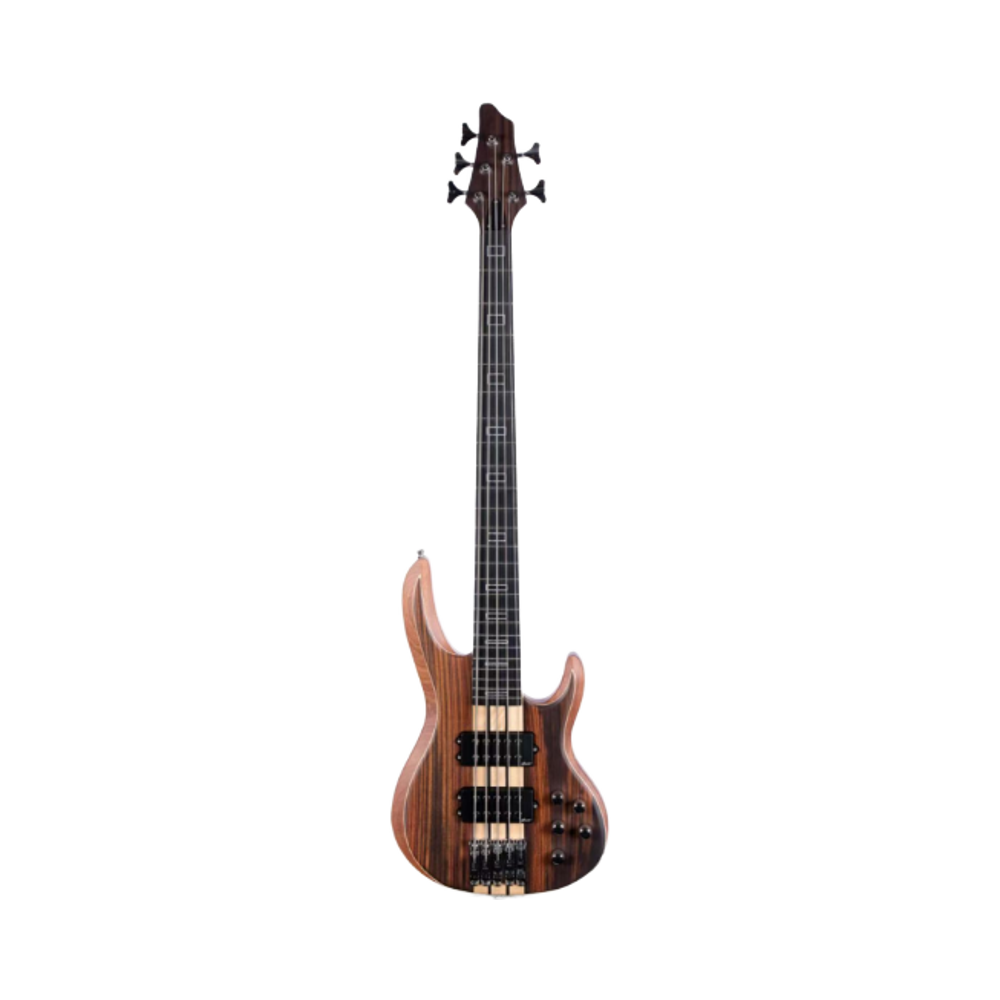
Gusto Guitar GTBS5P-07 reference image. Confirm the current instrument’s tuning, string spacing and other specifications before ordering.
Compare 4-string vs 5-string bass range and playing needs
A commonly used four-string tuning, from lowest to highest, is E–A–D–G. A common five-string arrangement is B–E–A–D–G, adding a low B below the four familiar strings. Yamaha’s alternate bass tunings guide explains both the standard tuning context and alternatives, including a five-string arrangement with a high C instead of a low B.
Therefore, “five-string” describes the number of strings, not the complete tuning. Ask which arrangement the instrument is designed and set up for. If your reason for buying is access to notes below E, an instrument configured with an added high string does not meet that requirement without further consideration.
With a low-B five-string, the additional low notes can be useful when a part requires them, while the extra string also provides alternative places to play notes already available elsewhere. These are two separate benefits: extended range and a different choice of position. Work out which one matters to your music before deciding.
Read your repertoire before reading the catalogue
Choose several songs or arrangements you genuinely expect to play. Mark any notes below the low E of a standard four-string. Then ask whether those notes are required in that octave, whether an octave alternative is musically acceptable and whether the band regularly changes keys.
A five-string may make particular transpositions or low-register parts convenient, but it does not remove the need to learn the fingerboard. Write out a representative line in two positions and compare the movement. If the added string lets you keep a useful position through the phrase, that is a concrete reason to consider it.
Conversely, if your repertoire fits comfortably on a standard four-string and you prefer that instrument’s physical layout, there is no obligation to add another string. Make the decision around recurring musical needs rather than a possible future task so vague that it can never be tested.
Compare three different dimensions of comfort
Neck width and shape
String count alone does not tell you the feel of a neck. Nut width, thickness, profile and the width farther along the fingerboard all matter. Hold each candidate and play the low positions you use most often. Notice whether the thumb and wrist can remain comfortable while reaching the lowest string.
String spacing
The picking hand experiences the spaces between strings as well as the overall width. A compact five-string layout may feel different from a more widely spaced four-string, especially if your technique depends on a particular spacing. Ask where a quoted measurement was taken and try the actual instrument rather than comparing isolated numbers.
Balance and reach
Check standing balance on a strap and seated reach. The same nominal scale length does not guarantee identical hand position because the body and strap-button layout also affect where the bass sits. A measured weight is useful, but it cannot show whether you will spend a rehearsal supporting the neck with your fretting hand.
For a documented example, Ibanez lists its SR305E with a 34-inch scale, 45mm nut width and 16.5mm string spacing. These figures describe that specific five-string model. They demonstrate why a specification needs several fields; they are not default measurements for all five-strings or Gusto instruments.
Include muting in the comparison
An unused string must remain controlled when another note is sounding. With a low-B five-string, play a line that does not use the B string and listen for unwanted ringing. Then move onto the B string and back. The transition tells you more about your current control than an isolated impressive low note.
Try the technique you actually use: fingers, pick, slap or a combination. Observe how both hands stop notes and how easily you can maintain that control during a position change. There is no need to declare a five-string inherently difficult; the point is to discover which habits you will need to practise.
For a beginner, have a teacher demonstrate a simple muting approach on the candidate instrument. A bass that feels comfortable and suits the intended music can be a reasonable starting point with either string count. Learning support and a manageable setup are more useful than a rule that everyone must begin with four strings.
Judge the low string through a musical line
If low-register playing is the reason for considering five strings, do not audition only the open B. Play fretted notes on that string and move between it and the E string. Listen to whether the line remains understandable at the intended tempo and playing level.
Keep the amplifier and processing documented. Excessive low-frequency boost can make a demonstration sound large while obscuring the timing and pitch information you need. Start with a clear, usable sound and adjust gradually. Compare the response within a representative accompaniment as well as in isolation.
Neither scale length nor price alone establishes the usefulness of a low string. The complete instrument, strings, setup, amplification and player contribute to the result. If you are buying remotely, request a short passage that includes fretted low notes rather than relying on a sustained open-string clip.
A comparison sheet that keeps the decision specific
| Requirement | Four-string question | Five-string question |
|---|---|---|
| Required range | Does the agreed tuning cover the actual parts? | Is the extra string low B, high C or another confirmed tuning? |
| Position choices | Are shifts comfortable in the intended keys? | Does another fingering route improve the relevant passages? |
| Hand comfort | Does the particular neck and spacing suit you? | Can you reach and separate all strings without unwanted tension? |
| Note control | Can you stop unused strings throughout the line? | Can you also control the additional string during transitions? |
| Ownership | Are suitable strings and service support accessible? | Is the exact string set and setup documented and replaceable? |
Consider alternate tuning as a separate decision
A four-string can be configured for a different tuning, but that is not the same as assuming any stock instrument is ready for it. Yamaha discusses B–E–A–D and other alternate tunings in the guide above. Changes may require suitable strings and setup work; confirm compatibility with a competent technician.
The trade-off also changes the available upper range and familiar fingering map. If your part needs both low notes and the usual G string, removing that upper string from the arrangement may not solve the whole problem. Write down the complete required range rather than focusing on the lowest note alone.
Avoid buying a bass with an unspecified future conversion as the only plan. Ask for the intended tuning, approved string set and setup arrangement in the order. That turns a theoretical possibility into a configuration someone has agreed to supply and support.
Keep electronics separate from string count
Four strings do not imply passive electronics, and five strings do not imply active electronics. Check pickup type, onboard controls, power requirements and output arrangements independently. A battery requirement should be confirmed from the actual model rather than inferred from the number of knobs.
This separation matters in demonstrations. If the five-string sample has a different preamp and pickup system from the four-string, the sound comparison includes those differences. Record them so you do not attribute every audible change to the added string.
A practical test before making the final choice
Play one familiar groove on both basses, then a passage that genuinely uses the extra range or position choice. Spend enough time on each to check comfort and note control. If possible, repeat the trial another day rather than letting the novelty of a new layout determine the result.
Finish with the ownership questions: exact tuning, string gauges, setup, case fit and access to replacement parts. For remote purchasing, retain the demonstration and approved specification. The best choice is the bass whose benefits you can describe in your music and whose compromises you can manage in practice.
Compare complete instruments in the electric bass range before selecting a string count. Check the intended carrier against the bag and case options separately, particularly when body size and neck length differ.
Questions that often settle the choice
Is five-string bass only for advanced players?
No. Suitability depends on the player’s goals, physical fit, setup and learning support. Extra muting and navigation tasks should be understood, not treated as a prohibition.
Does a five-string always sound deeper?
It may offer lower notes in a low-B tuning, but the sound of shared notes also depends on the complete instrument and signal chain. Compare the same phrase under clear conditions.
Should I replace a four-string that already works?
Only if another instrument solves an identified need or provides a playing experience you value. More available notes do not make your existing instrument obsolete.
Browse Gusto Guitar’s electric bass range and request confirmed tuning, dimensions and a relevant sample demonstration for the model you are considering.

Get Best Guitars
Join Gustoguitar.com Newsletter to get more information of electric guitars, classical guitars, and all kinds of guitars.


