

 By Gusto Guitar
Read the layer stack beneath the finish: visible flame, a maple cap and a decorative veneer describe different things, and more than one can be present on the same guitar.
Comparing flamed maple tops vs veneers requires a clear description of the decorative layer, its thickness and the construction underneath it. A guitar can have a maple top with a figured veneer over it, so “top or veneer?” is not always an either-or choice. The useful enquiry identifies each layer, what the supplier means by its terminology and what evidence supports the description.
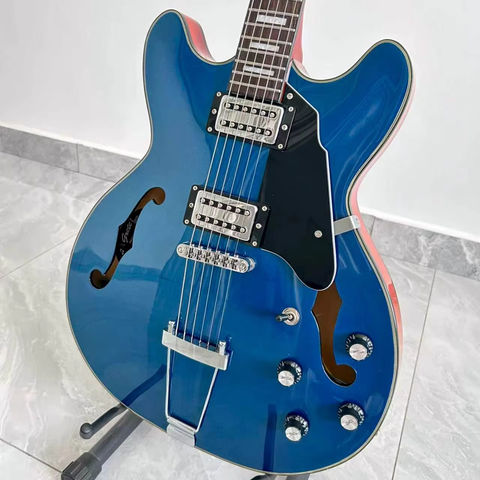
Gusto Guitar exterior reference image. A finished front view does not by itself establish a top’s thickness, layer count or use of veneer.
Identify the layers in flamed maple tops vs veneers
Flame describes a visible figured appearance in the wood. It does not state the thickness of the piece carrying that appearance, whether another wood layer sits underneath or whether the surface is a different decorative treatment. Those questions need their own fields in the specification.
A top or cap commonly refers to a distinct layer forming the upper part of a body assembly. A veneer is a thinner facing used as a surface layer. The exact thickness and construction should be requested rather than inferred from those words alone. Suppliers may use informal terms differently in short catalogue titles.
A printed or otherwise applied pattern is a further possibility to distinguish from actual figured wood. A photograph can show an attractive result without proving how it was made. Ask what the pattern-bearing surface is instead of assuming every flame-looking image represents the same material.
A maple top and a maple veneer can coexist
PRS provides a clear manufacturer example. Its series comparison lists the SE Custom 24 top as maple with figured maple veneer, while other compared models have their own top descriptions. This wording identifies two layers rather than asking the reader to choose between a maple top and a veneer.
That example should not be copied into the specification of another brand. Its value is in showing how precise wording resolves ambiguity. If a proposed guitar is described only as “flamed maple top,” ask whether the figure belongs to the cap itself or to a facing above it.
For a buying record, draw the layers in order from the visible surface downward. The finish is one layer of description, the decorative wood face another, any cap another and the main body another. A simple written stack is often enough to reveal what remains unanswered.
Three illustrative descriptions and what they mean
| Illustrative description | What it tells you | What still needs confirmation |
|---|---|---|
| Figured maple cap over a body core | The stated cap itself carries the figure. | Cap thickness, core material, joints and finish. |
| Figured maple veneer over a maple cap and body core | A decorative facing and a separate cap are both specified. | Each layer’s thickness and the underlying body construction. |
| Figured veneer over a body core without a separate cap | The described decorative layer is not accompanied by a separate cap. | Facing thickness, core material and surface shape. |
| Flame-look finish with no wood-layer description | Only the intended visual result is clear. | Whether the pattern is wood figure or another decorative process. |
These are examples of how to write a specification, not claims that Gusto offers every construction above. The order document should describe the actual proposed model, including any option-specific differences.
Why a front photograph cannot settle thickness
The camera shows the outer surface. A thin facing can display strong figure, while a thicker piece can display a more restrained pattern. Pattern intensity is therefore not a reliable thickness measurement.
A centre seam also has limits as evidence. It can help describe the visible layout, but it does not reveal every layer beneath it. Likewise, binding can cover an edge that might otherwise show part of the assembly. The absence of an obvious layer line is not proof that there is only one layer.
Do not ask an owner to scrape a finish, enlarge a cavity or otherwise damage a guitar to answer a purchasing question. Seek the maker’s specification, suitable manufacturing-stage photographs or an annotated construction drawing. Any inspection requiring disassembly should be agreed and performed appropriately.
Ask for evidence that matches the disputed detail
If the question is thickness, request a measurement or drawing identifying where it applies. A carved surface may not have the same thickness at every point, so one unexplained number can be misleading. Ask whether the stated value is a nominal starting layer, a finished location measurement or another definition.
If the question is which layer carries the figure, request a description or relevant production photograph before finishing. A close-up of the completed front simply repeats the view that created the uncertainty.
If the question is authenticity of the material description, ask how the supplier identifies and records the layers. A broad assurance of high quality does not answer a specific construction question. Keep the response with the sample approval so later orders do not restart the same ambiguity.
Do not confuse a carved outline with a solid figured cap
A sculpted or arched surface tells you about shape. It does not independently establish the material stack. Ask how the contour is constructed and how any decorative facing relates to that contour.
This matters around edges and cutaways, where a finish may be opaque or where a different surface becomes visible. Approve those areas as part of the appearance brief. A front-only sample image can omit exactly the transition that becomes important when the instrument is held at an angle.
For a semi-hollow instrument, also keep the structural description separate. Do not turn the word maple into an assumption about a solid carved top, laminated panels or internal support. Ask the maker to describe that assembly directly.
Understand figure grades within the maker’s system
PRS explains its own maple classifications in Maple Top Grading. The important lesson for another purchasing conversation is to obtain that supplier’s grading criteria, rather than transfer a named grade from a different maker.
Terms such as AAA or premium need a defined visual meaning in the agreement. Ask what consistency, coverage and variation they permit. Do not assume a grade is a universal engineering standard, a thickness specification or a guarantee of better sound.
Where appearance is central to the sale, retain representative photographs under ordinary lighting and identify whether approval concerns a particular instrument or a range for a batch. Wood figure can present differently as the viewing angle and lighting change, so a single dramatic photograph is an incomplete reference.
Keep tonal claims separate from visual evidence
A more dramatic surface does not prove a more desirable amplified response. Two guitars can differ in pickups, bridge, scale, construction and setup as well as top appearance. A listening preference between them does not isolate the contribution of the decorative layer.
If sound is important, evaluate the complete sample using passages relevant to your music. If appearance is the reason for the upgrade, say so clearly. A decorative veneer can serve a deliberate visual brief without being misrepresented as a thick figured cap.
Similarly, do not infer low quality from the presence of veneer alone. Assess the accuracy of the description and the workmanship of the completed instrument. The problem is an undisclosed or misunderstood construction, not the existence of a particular layer.
Write an approval record that can survive a repeat order
Record the main body material, cap if present, facing if present, approximate or agreed thickness definitions, surface contour and finish. Give the sample a stable identifier and date. Attach the evidence used to resolve any ambiguous wording.
Next, specify which changes require approval. Replacing a figured cap with a decorative facing is a construction change, even if the front looks similar. A normal grain variation within an agreed range may be a different kind of issue. Keeping those categories distinct makes supplier communication more precise.
Finally, ensure the public product description uses the same language as the approved record. If a supplier clarifies that a model has a veneer over a cap, update an earlier vague phrase rather than retaining a more impressive but misleading implication.
Questions to send with a sample request
Is the visible figure part of the cap or a separate veneer?
Ask for an explicit answer naming the layers in order. Neither a model nickname nor a front photograph fully answers this.
Can a guitar have both a maple top and a veneer?
Yes. The PRS example above documents that arrangement. Confirm the construction of your own proposed model rather than assuming it matches.
Does a highly figured appearance prove a thick top?
No. Appearance and thickness need separate evidence. Request the relevant specification and approved visual reference.
Explore Gusto Guitar’s solid-body category and semi-hollow category, then request a layer-by-layer description for any proposed figured-top option before approving the order.

Get Best Guitars
Join Gustoguitar.com Newsletter to get more information of electric guitars, classical guitars, and all kinds of guitars.


