

 By Gusto Guitar
Read the layout, then read the wiring: HH, HSS and SS identify pickup arrangements, while the useful sounds depend on the actual pickups and what each switch position connects.
Comparing HH vs HSS vs SS pickups requires the installed pickup types and circuit to be identified, since layout letters do not specify every sound or control function. The arrangement tells you where the main pickup types sit. It does not tell you every available combination, how evenly the settings balance or whether a push-pull control splits a coil. This guide turns the shorthand into a practical way to compare a guitar, write a sample request and avoid buying functions that only exist in an assumed wiring diagram.
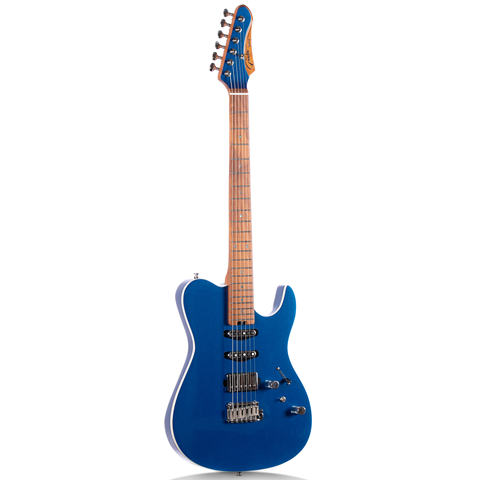
Gusto Guitar GTTL-03 reference image. Confirm the current layout and switching functions from the model specification, not the visible covers alone.
Read HH vs HSS vs SS pickups as layouts, not complete circuits
Fender’s pickup-arrangement guide uses S for single-coil and H for humbucking, reading from the bridge toward the neck. In that convention, HSS places the humbucker at the bridge, followed by middle and neck single-coils. HH describes two humbuckers; SS describes two single-coils.
This ordering matters when a supplier writes SSH instead of HSS. It may be using the opposite direction rather than proposing a different physical layout. Ask for a bridge-to-neck map or an annotated photograph before concluding that the two descriptions disagree.
The letters describe pickup types in the stated arrangement, not merely the shape of the covers. If a pickup is unusually sized, noiseless or built to resemble another format, request its actual identification. A small rectangular unit is not enough evidence to classify its internal design.
What each arrangement brings to the shortlist
HH: two humbucker positions
With humbuckers at bridge and neck, start by comparing those two positions and their combined setting if available. Listen to whether each is useful for your music and how the transition works. An HH guitar may also include extra wiring options, but the letters do not promise them.
HSS: a mixed bridge, middle and neck arrangement
HSS is worth investigating when you want a bridge humbucker alongside single-coil positions. The important question is how those settings work together on the actual instrument. Check the output change and the available combined settings rather than assuming that three pickups automatically cover every sound.
SS: two single-coil positions
An SS arrangement can provide a straightforward set of choices without a middle pickup. That is not a deficiency if the available settings meet the musical brief. Compare the bridge, neck and any combined position through the parts you play instead of counting the number of controls as a quality measure.
The switch-position table matters more than a knob count
Ask the supplier to list what each selector position connects and what every additional switch changes. A five-position lever does not universally mean the same five sounds, and a three-position toggle does not tell you whether other controls alter the circuit.
Schaller’s Megaswitch documentation provides different circuits for pickup configurations and switch models. It illustrates why physical switch style and pickup layout are not a complete wiring specification. The installed circuit needs to be identified.
For a sample approval, use plain language such as bridge pickup alone, bridge and middle together, or the named coil combination. If the seller uses position numbers, identify the direction. Otherwise, two people can agree on position two while referring to opposite ends of the selector.
Do not confuse coil splitting with every other switching function
A coil split uses part of a multi-coil pickup arrangement rather than its ordinary full-coil operation. Other switching functions can connect coils or pickups in different ways. The existence of a push-pull knob does not establish which function it performs.
Ask what changes when the control is pulled and which selector positions are affected. Then have that change demonstrated. Do not advertise a split just because a copied template includes the term, and do not assume a split setting duplicates a separate traditional single-coil pickup exactly.
If the full technical diagram is unfamiliar, request both the diagram and a customer-facing explanation. A technician needs the former for service; a player needs the latter to operate the guitar without guessing.
Build the comparison around actual musical tasks
| Task | What to compare | What to record |
|---|---|---|
| Clean accompaniment | A chord progression on each useful setting. | Clarity and the settings you would actually use. |
| Driven rhythm | The same riff at documented gain and listening level. | Attack, note separation and noise during rests. |
| Lead transition | Change from accompaniment to lead without rebuilding the rig. | Practical volume and tonal adjustments. |
| Combined positions | Every combination listed in the approved switch map. | Whether each is distinct, balanced and useful. |
| Extra controls | Each push-pull, mini-switch or other documented function. | Exactly which settings change. |
Use this sheet across HH, HSS and SS candidates. A configuration with fewer settings can still be the stronger choice if its useful settings match the brief and are easy to reach during playing.
Check balance between pickup positions
Play a repeated phrase while switching between positions without touching the amplifier. Listen to the change in level and character. Some contrast may be desirable, but decide whether it creates an inconvenient jump for the way you use the guitar.
Next, try the guitar’s own volume and tone controls. Can you make the transition practical with a small repeatable adjustment? If the solution requires several changes during a short musical passage, note that limitation rather than ignoring it because the isolated sounds are attractive.
For a remote demonstration, request unchanged amplifier settings for this part of the test. A clip edited to normalize each segment can conceal the exact transition you need to evaluate.
Assess noise in the settings you intend to use
Humbucking designs are intended to reduce a kind of unwanted electromagnetic interference, as Fender explains in its cited guide. That does not promise a silent complete guitar under every condition. Cables, wiring, surroundings and gain settings still belong in an assessment of the actual noise.
Test with the strings muted and the intended signal chain documented. Compare the settings in the same location rather than moving the guitar between unrelated rooms. Do not infer the noise behaviour of all HSS positions from the presence of a bridge humbucker.
If a combined single-coil setting is advertised as hum-cancelling, request confirmation for that specific wiring and pickup pairing. The layout letters alone cannot verify it. A useful sample report names the position and conditions instead of saying simply quiet pickups.
Separate pickup arrangement from output and power requirements
HH does not mean every pickup has high output, and SS does not establish that every model has the same response. Ask for the actual pickup model or an agreed specification and listen to the complete guitar.
Likewise, the arrangement does not determine whether a battery is needed. Confirm any active electronics, power requirements and operating instructions independently. A row of knobs or a covered pickup is not a reliable substitute for this information.
When comparing quotations, check whether the pickup change also alters the controls, switch or other components. Otherwise, a price difference may be attributed to one letter while the underlying electrical specification changes more substantially.
Think about service before approving a configuration
Keep the wiring diagram, pickup identification and control map with the model record. If a replacement is needed later, the technician should not have to reconstruct the intended function from a promotional photograph.
For physical replacement, confirm dimensions, mounting and compatibility. A pickup described as humbucker-sized or single-coil-sized still needs to match the particular guitar. Do not approve routing or other irreversible work merely because the configuration name looks familiar.
For repeat orders, distinguish an approved functional equivalent from a visually similar substitution. If a pickup or switch changes, recheck the positions and public description before treating the batch as identical.
Which arrangement should you choose?
Choose HH when the tested humbucker positions and any confirmed options fit your work. Choose HSS when the actual mixed layout provides useful bridge-to-neck alternatives. Choose SS when its two positions and combinations cover the task without unnecessary complexity.
These are decision conditions, not genre restrictions. The same arrangement can serve different musical styles, and different arrangements can both meet one player’s needs. A clear demonstration is more reliable than an absolute rule about which letters belong to which music.
Does HSS always include a split bridge pickup?
No. Confirm the circuit and demonstrate the relevant control. The letters identify layout, not every switching option.
Can SSH mean the same layout as HSS?
A seller may be reading the positions in the opposite direction. Ask for a bridge-to-neck map before accepting either label.
Compare Gusto Guitar’s solid-body range and semi-hollow options, then request the exact pickup and switching specification for your proposed guitar.

Get Best Guitars
Join Gustoguitar.com Newsletter to get more information of electric guitars, classical guitars, and all kinds of guitars.


