

 By Gusto Guitar
Count selectable positions, then verify what each position actually connects.
Guitar pickup switches should be compared through their actual wiring and position-to-function map, not the number of positions alone. The circuit behind the selector determines that result. Two guitars with five positions can have different functions, and a three-position instrument can include additional switching elsewhere. This guide explains how to compare the practical choices, document the circuit, and test an actual guitar without assuming a standard wiring pattern from a photograph or a familiar body shape.
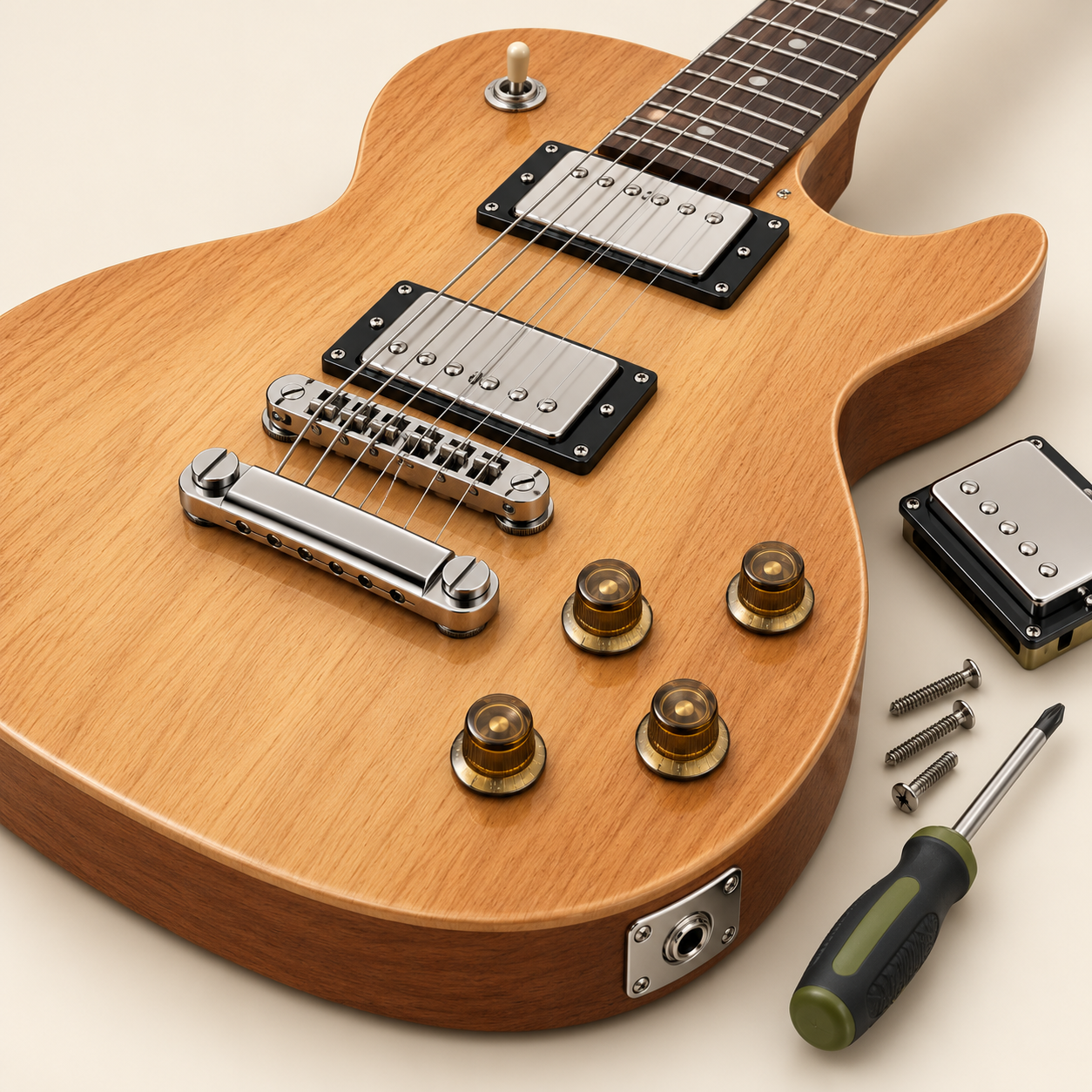
Map the functions of guitar pickup switches
Start by counting the pickups and identifying their confirmed construction. Then list the selector positions as a separate field. Do not assume that a five-way guitar has five pickups or that a two-pickup instrument must use three positions. A circuit can combine pickups or access different coil arrangements when its components and wiring support that design.
The useful buyer question is what changes at each stop. A clear function map should state the active pickup or coil arrangement in plain language. Number the positions and define the viewing convention, such as counting from the bridge end. Otherwise, two people can agree that position one works while referring to opposite ends of the switch.
Understand a common three-position example
A hypothetical two-pickup guitar might select bridge, both pickups, and neck across three positions. This is a familiar example, not a guaranteed description of every three-way instrument. The combined position can also depend on the actual wiring. Ask for the function of the quoted model rather than copying a generic table into its specification.
A player may value this arrangement because the choices are easy to locate during performance. Simplicity can be a deliberate feature rather than a lack of capability. Evaluate whether the three sounds meet the playing brief and whether any extra controls are understandable. More switching is not automatically useful if the player cannot identify the required sound reliably.
Understand a common five-position example
A hypothetical three-pickup circuit might select individual pickups at some positions and combinations at others. Another five-position circuit might use two humbuckers with different coil functions. These are different designs even though the selector has the same number of stops. Ask for an actual model-specific map rather than inferring the circuit from the selector count.
Seymour Duncan’s official wiring library distinguishes pickup configurations, controls, and selector types. That organization is a useful reminder that a diagram must match more than the word five-way. It does not prove that a particular Gusto instrument uses a listed circuit or the same wire-color conventions.
Do not confuse a selector with a coil-split control
Coil splitting is a separate circuit function that may be operated by a selector, a push-pull control, or another switch. A five-way selector does not automatically provide it. A three-way guitar may offer it through an additional control. Record the complete control layout so that the player understands how the functions interact.
Ask whether an advertised function changes a whole pickup, one coil, a pickup combination, or another part of the circuit. Avoid using vague descriptions such as single-coil mode without clarification. If a supplier cannot explain the intended result, keep the function unverified and request a corrected specification before approving the instrument.
Compare usability during actual playing
Try selecting sounds while holding the guitar normally. Check whether the switch is easy to reach without being knocked unintentionally. A toggle and a blade can place the hand differently even when their function maps are similar. Evaluate the actual location and travel rather than assuming one style is always faster or more reliable.
Use a short playing sequence that requires the changes you normally make. Notice whether the chosen positions are easy to recognize by feel and whether extra switching creates confusion. A player who mainly needs a neck and bridge contrast may prefer a different layout from someone who uses several combinations within one piece. The buying decision should follow that use.
Check the whole control interaction
Move volume and tone controls in each relevant selector position. On some circuits, controls affect only selected pickups; other circuits use shared controls. Do not infer those assignments from the number of knobs. A complete map includes which control acts on which signal and what any additional switch changes.
Keep a written record of intended behavior before testing. Otherwise, an unfamiliar but correct circuit may be reported as defective, or an incorrect function may be accepted because it produces some sound. Clear expectations make the test both fair and repeatable. They also improve the eventual product description and customer instructions.
Verify physical compatibility before modifying
Replacing a switch can involve cavity depth, mounting spacing, lever clearance, and the electrical contacts available on the component. A part with the right number of positions is not necessarily a direct replacement. Request the actual component dimensions and circuit requirements before ordering parts or planning a modification.
Do not assume that adding two positions to a guitar is a simple upgrade. The required circuit may need a different switch construction, pickup leads, or other components. Have a suitable technician assess the proposal when the design is uncertain. Keep the approved wiring and component reference with the instrument so later service does not rely on guesswork.
Test functions through a known signal chain
Use a working cable and amplifier and establish a sensible test level. Check every position systematically, then repeat any suspect result. Record silence, intermittent output, or a function that differs from the agreed map. The goal is to identify a repeatable discrepancy, not diagnose every electrical cause from one listening impression.
Compare like conditions when evaluating noise or output balance. Different pickup arrangements can behave differently, and an audible change between positions does not automatically indicate a fault. A noise concern should include the environment, amplifier settings, and affected positions. This gives the supplier or technician useful information for assessment.
Write product information that answers the real question
A specification that says five-way switch leaves the customer to imagine the sounds. Add a concise position map once verified. If the circuit has an additional split control, explain its interaction without promising that it duplicates another type of instrument. Keep terminology consistent across the title, table, and buying guide.
Avoid implying affiliation with a famous brand because the body outline or circuit resembles a familiar example. Describe the actual configuration in neutral terms and identify any branded components only when confirmed. A clear, honest function map is more useful than a borrowed model name that leaves the actual supplied electronics uncertain.
Plan a wholesale approval record
For an order, approve the selector type, component reference where available, position map, control assignments, and sample behavior. Ask how substitutions will be handled. Another five-way part may not implement the same circuit or fit the same cavity. A change needs review against the agreed functions rather than acceptance based on position count alone.
Include electrical function checks in the inspection plan. Decide whether every instrument will be tested and how results will be recorded. Keep failures tied to instrument identity so reinspection can confirm the relevant correction. A photograph of the switch lever proves little about what happens electrically at each stop.
Make position labels usable by the next person
If a manual uses numbered positions, show the direction of numbering on a simple reference photograph or approved diagram. Define whether the guitar is viewed from the player or the front. Keep that convention consistent in inspection sheets and customer instructions. This avoids a genuine function being reported incorrectly because two people count from opposite ends. When a revised circuit changes one position, update the map and the test record together so the old instruction does not continue with a new instrument.
Compare the control requirements of the solid-body guitar range and the semi-hollow and jazz range using a position-to-function record. Similar-looking selector switches do not establish identical wiring.
Choosing between three and five positions
| Item | Three-way | Five-way |
|---|---|---|
| Selectable stops | Three | Five |
| Pickup count | Must be verified separately | Must be verified separately |
| Coil split | Not established by position count | Not established by position count |
| Useful evidence | Actual function map | Actual function map |
| Replacement fit | Dimensions and contact arrangement | Dimensions and contact arrangement |
| Final choice | Match useful functions to player | Match useful functions to player |
Choose the layout that provides the useful sounds and control access needed by the player. More positions can increase options, but only a verified circuit can tell you what those options are. Fewer positions can be easier to navigate, but simplicity should still be assessed against the actual musical requirement.
Start with a model in the Gusto Guitar product range and request its current pickup and control map. Compare that complete arrangement with your needs before deciding that three-way or five-way is inherently better. The result should be a guitar whose controls are understandable, functional, and accurately documented.

Get Best Guitars
Join Gustoguitar.com Newsletter to get more information of electric guitars, classical guitars, and all kinds of guitars.


