

 By Gusto Guitar
Design the complete packing and handling system, then verify it for the actual shipment.
Bulk shipping electric guitars requires a packing plan that controls movement and protects vulnerable areas throughout the intended journey. Each instrument requires suitable support and separation, while the complete shipment must match its handling route. A packing arrangement that works for one body shape or delivery method may be unsuitable for another. This guide explains how to define and verify a bulk packing plan without inventing a universal carton quantity, claiming an unperformed transport test, or presenting a proposed packaging design as a current Gusto standard.
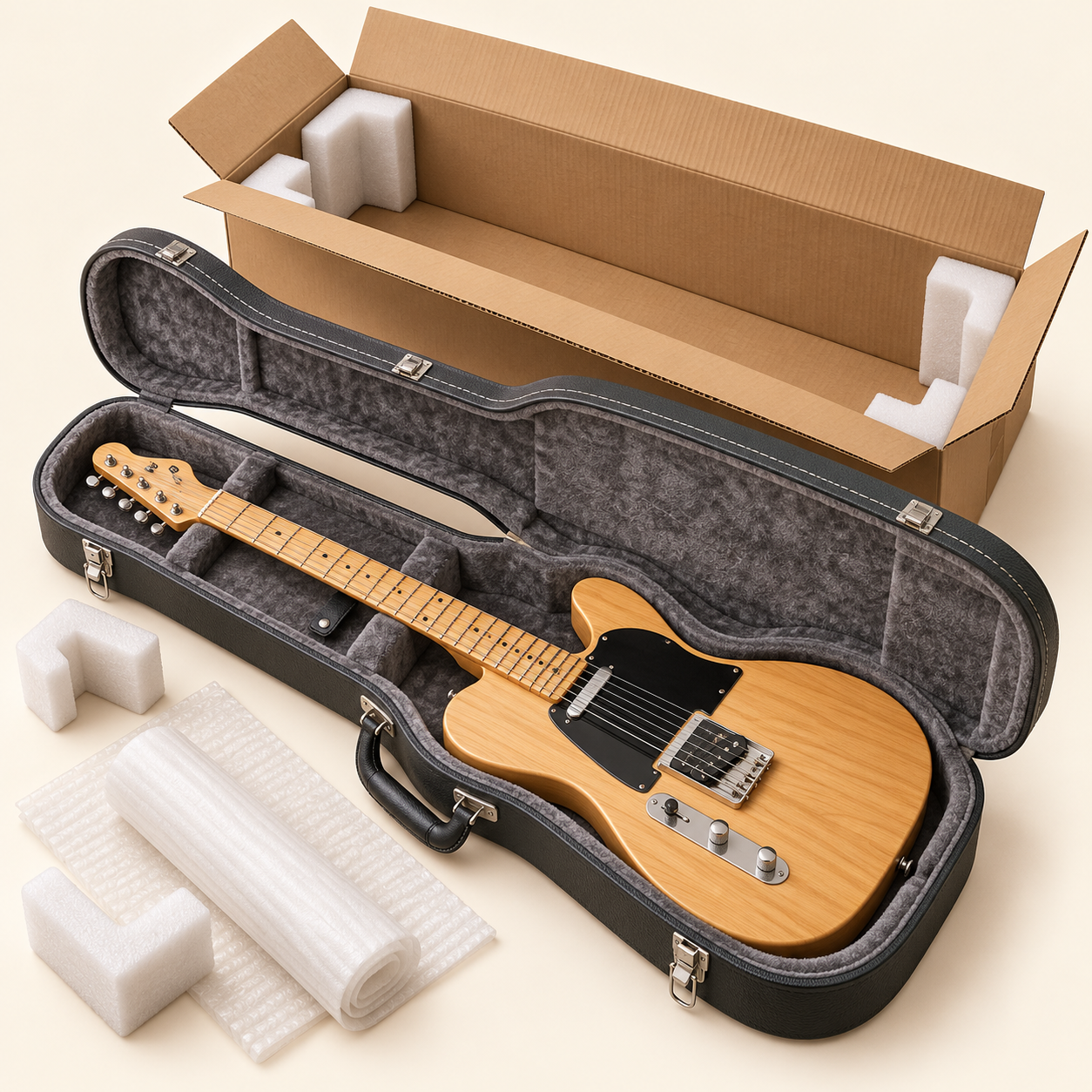
Define the journey before planning bulk shipping
Identify the instrument configurations, quantities, accessories, destination, and expected handling route. Clarify whether the goods move as individual parcels, consolidated cartons, or another freight arrangement. These are different conditions. A packaging decision should follow the actual route rather than a generic statement that the order is export packed.
Record who prepares the instruments, who approves the packaging, and who arranges transport. Keep those responsibilities visible in the order record. This is a proposed coordination method, not a legal interpretation of delivery terms. Confirm current commercial and carrier requirements with the parties involved before dispatch.
Protect each guitar as an individual item
Check how the body and neck are supported and which projections need clearance. Bridge parts, tuners, controls, and strap buttons should not become unintended pressure points. A shaped body or angled headstock may need a different arrangement from a conventional outline. Do not assume a larger empty cavity is safer if it allows movement.
FedEx’s guitar-shipping guidance emphasizes securing the instrument and cushioning the packaged shipment. That carrier example supports treating protection as a complete arrangement. It does not certify a Gusto bulk package or establish that one parcel-packing method is sufficient for every freight route and instrument construction.
Keep accessories from becoming impact sources
List what travels with each guitar and where it is restrained. Loose tools, removable arms, cables, or other objects can contact the finish if their storage is not controlled. Use the maker’s instructions for removable components. Keep sharp string ends and small metal pieces away from linings and vulnerable surfaces.
Confirm that accessory compartments do not create pressure against the guitar when the package closes. A photograph with an empty pocket may not represent the shipped condition. Approve the actual loaded arrangement, including documents and protective covers where supplied. Record bundle contents separately from optional items shown in marketing photographs.
Separate instruments inside a consolidated package
Prevent instrument-to-instrument contact and establish how each unit remains in its intended position. Dividers, individual containers, and other protective elements should be evaluated for the actual load and route. Do not choose a carton quantity only because a previous listing mentions a convenient number of pieces.
Check whether the arrangement can be packed consistently by different operators. A design that depends on an undocumented hand placement or improvised filler is difficult to inspect. Create a clear packing sequence and reference photographs. If several instrument shapes share a shipment, confirm that the same insert or orientation genuinely suits each one.
Evaluate the outer package and closure
Agree the relevant carton or container specification, dimensions, closure method, and identification. Keep internal and external dimensions distinct. A box that looks substantial is not proof of a defined strength or transport performance. Request the appropriate packaging information and verify that it applies to the actual supplied package.
Do not rely on a fragile label as a substitute for protection. Labels communicate handling information but do not eliminate impact, compression, or movement. The package should be designed for the expected system and its documented requirements. If special handling is necessary, confirm that the service actually provides it rather than assuming that a printed warning guarantees it.
Address the complete handling route
Consider how cartons are lifted, stacked, transferred, stored, and opened. For palletized or consolidated freight, discuss restraint and package interaction with the relevant packaging and logistics specialists. A method suitable for an individual parcel may need further evaluation when cartons bear on one another or travel as a larger unit.
Record any restrictions that matter, such as orientation or maximum handling load, only when supported by the actual package and service arrangement. Do not invent a test rating or assume that a general material specification proves performance of the loaded unit. The instrument, inner protection, outer package, and handling route belong in the same assessment.
Treat climate and moisture separately from cushioning
Impact protection does not automatically provide moisture control. Ask what exposure is expected and what protection the package actually offers. Keep the instrument maker’s care instructions in view. A sealed-looking wrap can create other concerns if the contents or packing materials are already wet, so avoid simplistic claims that more sealing always solves the problem.
If humidity management is required, agree the approach with suitable technical input and verify the materials used. Do not place unapproved products against the finish or assume an arbitrary packet controls every shipment. Record the intended function and evidence. This guide does not prescribe a universal desiccant quantity or storage-humidity target for all guitar constructions.
Agree testing before claiming protection
If transport testing is required, define the method, load, sample configuration, conditioning, and decision criteria with the appropriate parties. A successful test of one carton size or instrument arrangement should not be extended automatically to another. Retain the report and identify exactly what it covers.
A packing photograph is not a drop-test result. A supplier’s statement that similar goods have shipped before is not the same as evidence that this design meets a defined test. Keep practical history, visual inspection, material specification, and formal performance testing separate. Each can be useful when described at its actual level of certainty.
Inspect the packing process before closure
Verify instrument identity and condition before it becomes inaccessible. Check supports, separation, accessory restraint, and the correct packaging revision. Photograph representative stages with enough context to understand them. Decide in advance which checks cover every unit and which use an agreed sampling approach.
Do not mark a complete shipment inspected because one finished carton looks correct. Record the inspection coverage and any deviations. If a packing change is made to solve an issue, update the reference before continuing. An approved correction should be reflected in the actual process rather than remaining only in a message that operators may not see.
Make receiving identification straightforward
Use a carton and item record that lets the receiver connect instruments to the order and inspection evidence. Keep model, quantity, and bundle information accurate. Avoid labels that reveal unnecessary information, but do not make the receiver guess which instrument belongs to which record. Clear identification also helps isolate a problem without opening unrelated packages.
Provide sensible unpacking information where needed, especially if supports or removable parts are not obvious. The receiver should not have to pull against a restraint or discard a component that belongs to the instrument. Keep the instructions tied to the actual packing design and available in a useful form.
Plan how an exception will be handled
Agree what evidence is needed if damage or a shortage is found. Package photographs, instrument identity, visible condition, and retained materials may be relevant. Confirm current reporting and claim procedures with the supplier and carrier. Do not assume that a packaging choice creates insurance coverage or that one party automatically accepts every transport loss.
Use exceptions to improve the next packing review. Record whether the concern involved fit, separation, closure, handling, moisture, or another factor. Avoid changing the whole system based on a guessed cause. A focused assessment can identify which requirement or verification step needs revision.
Identify each instrument family through the solid-body guitar range and select the relevant bags or cases before approving a packing method. The inner carrier and outer transport packaging should be evaluated as separate parts of the shipment.
Build a model-specific shipping inquiry
| Layer | Define | Verify |
|---|---|---|
| Instrument | Identity and preparation | As-packed condition |
| Inner support | Body, neck, and hardware clearance | Loaded fit |
| Separation | No contact or uncontrolled movement | Actual consolidated arrangement |
| Outer package | Specification and closure | Correct package revision |
| Performance | Applicable handling or test conditions | Report scope |
| Receipt | Item and carton traceability | Clear unpacking record |
Identify the instruments in the Gusto Guitar product range and request the current proposed packing specification for the actual quantity and route. Ask what is established, what needs sample approval, and what performance evidence exists. Do not treat a historic carton quantity as a universal current promise.
A useful bulk-shipping plan is specific enough to pack, inspect, receive, and review. It supports every guitar within the complete shipment and keeps claims tied to actual evidence. That is a stronger basis for protection than a large box, a familiar packing phrase, or a photograph that leaves the critical supports unseen.

Get Best Guitars
Join Gustoguitar.com Newsletter to get more information of electric guitars, classical guitars, and all kinds of guitars.


