

 By Gusto Guitar
Separate species names, part locations, layer construction, and appearance evidence.
Guitar wood specifications should identify the exact component, layer and material claim before photographs or familiar wood names are treated as proof. A beautiful grain photograph, a familiar trade name, and a solid-wood phrase can answer different questions. Treating them as interchangeable makes a record look more certain than it is. This guide explains how to verify material claims for purchasing and product content without identifying species by color, assuming hidden layers, or turning another manufacturer’s construction into an unverified Gusto fact.
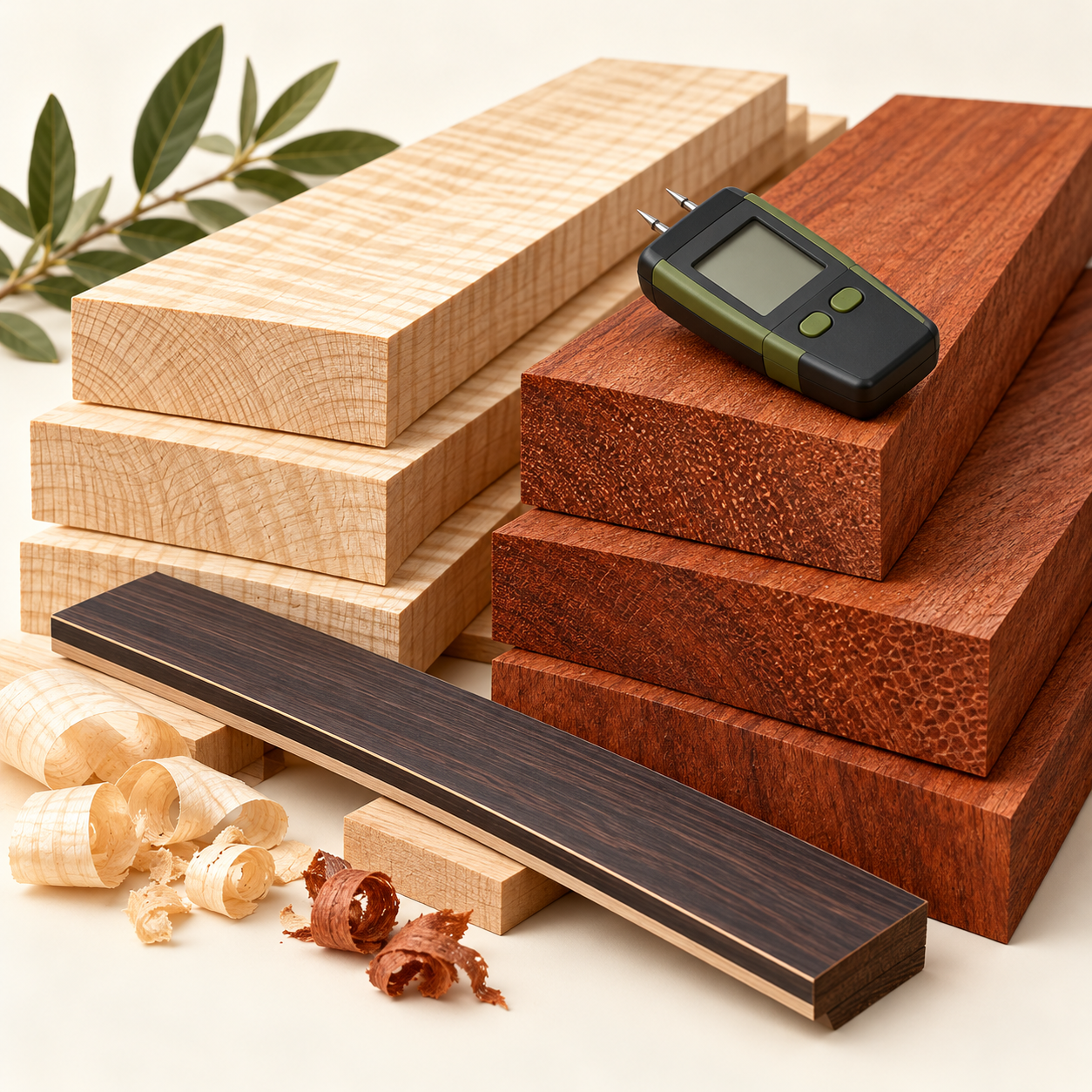
Identify each layer in guitar wood specifications
Create separate fields for the main body, any top or decorative layer, neck shaft, fingerboard, and other relevant parts. Do not put all wood names into one sentence and assume the reader can tell where they belong. A maple neck and a different body material can coexist in a completely consistent specification.
For each field, record the supplier’s exact supported wording. If the statement is broad, keep it broad until better evidence exists. Do not add a botanical name, country of origin, grade, or treatment because it seems likely. Verification begins with preserving what is actually claimed and identifying what remains unknown.
Distinguish species from commercial description
A commercial wood name may not provide all the precision a buyer needs. Ask whether the supplier can identify the exact material more specifically and what supports that identification. If precise species is essential, include it in the order brief and agree the evidence before approval. Do not demand a claim the supplier cannot substantiate and then publish it anyway.
Keep appearance grading separate. A visually attractive piece may still be described only by a broad trade term. An exact species declaration may say little about the selected figure or color. Both can matter, but one does not replace the other. Use separate evidence and approval fields so the distinction remains clear.
Clarify what solid means in context
Ask which part the word solid describes and how it is constructed. A statement about one component should not be extended to the entire instrument. Do not assume that solid excludes every joint or that a product using layers is necessarily misdescribed elsewhere. Request a plain-language construction explanation for the actual model.
Taylor’s official construction discussion distinguishes solid, layered, and laminate terminology in its acoustic context. The useful lesson is to describe layers explicitly. Its acoustic performance statements and particular constructions should not be copied into an electric guitar record or treated as proof of Gusto’s material arrangement.
Identify tops and decorative layers
Ask whether a visible surface is a separate structural top, a thin veneer, another decorative treatment, or the main body itself. Where thickness matters, request a supported value and its meaning. A figured appearance alone cannot establish the answer. Keep a layer diagram or clear written declaration with the specification if available.
Do not automatically rank the construction from the terminology. A buyer may require a particular appearance, a defined physical build, or both. State those goals separately. A decorative layer can meet an appearance brief while failing a requirement for a specific structural top, so the acceptance question should reflect what was actually ordered.
Use photographs for what they can show
Photographs can document visible grain, color, surface condition, and some construction features. They may help formulate a question, but they do not reliably prove every concealed material or exact species. Keep lighting and finish effects in mind when comparing images. An exterior color match should not be treated as a material test.
For production photographs, ask how the image is linked to the quoted model and revision. An undated workshop picture of a similar blank may not establish the construction of the finished sample. The image should support a traceable record rather than merely make the claim look plausible. Preserve context and identification where available.
Request evidence matched to the requirement
A supplier declaration, material purchase record, production drawing, and specialist identification each provide different information. Decide what the order actually requires and what level of verification is appropriate. Do not imply that an ordinary sample review is a laboratory species determination. Likewise, do not demand destructive analysis for a question that a controlled specification can reasonably resolve.
If independent material identification is required, agree the method, sample, responsible specialist, and decision criteria in advance. Keep that process separate from cosmetic approval and playing evaluation. This guide does not prescribe a universal test for every wood claim. The evidence should answer the actual purchasing question and be described accurately.
Verify treatment claims separately
Terms such as roasted, stabilized, selected, or aged need clarification when they matter to the order. Ask what process or selection is being claimed, which component it applies to, and what evidence supports it. A darker appearance alone does not establish a particular treatment. Do not add process claims to a product page based on a visual impression.
Avoid turning a treatment label into an unlimited performance promise. If stability, moisture behavior, or another property is important, define the claim and request suitable evidence. A process description and a measured performance result are related but different. Keep the wording at the level the available records support.
Connect material approval to a model revision
Retain the approved material sheet, sample identity, construction explanation, and relevant supporting records. State the variants it covers. A color change may not alter the material, while a visually similar revision may. Do not assume every member of a broad product family shares the same construction without confirmation.
Ask how substitutions are handled and who can approve them. If a material becomes unavailable, review the proposed alternative against the order’s requirements. A similar look or a familiar substitute name does not automatically establish equivalence. Keep the original and revised specifications so the decision can be understood later.
Keep sourcing and trade questions current
Material identity can affect documentation needs, but those requirements depend on the actual species, product, route, and current rules. Do not use an old instrument article as blanket legal guidance. Where current compliance advice is needed, consult official sources and an appropriately qualified adviser for the transaction.
Avoid unsupported origin, sustainability, or certification claims. Ask what document supports the exact statement and what its scope is. A general supplier policy does not necessarily certify a particular shipment. Keep those claims separate from the basic wood specification so an evidence gap is not concealed by an attractive environmental phrase.
Review the completed sample without overclaiming
Inspect visible workmanship and compare it with the approved appearance reference. Check the complete instrument’s function and playability under the agreed conditions. These observations matter, but they do not prove every concealed material field. Record which checks were direct and which relied on the controlled documentation.
If the sample conflicts with the record, preserve the discrepancy and ask for clarification before approval. Do not change the specification merely to match a guess about what arrived. The correct resolution may be a document correction, a sample correction, or additional evidence. Keep the decision and its basis visible.
Maintain accurate website language
Use separate body, top, neck, and fingerboard fields where relevant. Keep terms consistent across the title, table, description, captions, and SEO. Do not turn a general wood statement into a more specific claim during rewriting. A search-friendly phrase still needs the same factual support as a technical table entry.
For the Gusto Guitar product range, request current model-specific declarations before expanding material details. If a photograph is illustrative, say so where necessary. Good product content distinguishes visible appearance from verified construction and leaves no hidden assumption for the reader to treat as fact.
Keep the material request tied to a model in the solid-body electric guitar category. The solid body vs semi-hollow comparison helps separate a body-construction claim from a claim about a top, veneer or individual wood component.
A useful completion standard
| Claim | Clarify | Suitable record |
|---|---|---|
| Wood name | Exact supported wording | Model-specific declaration |
| Solid | Which part and construction? | Part description |
| Figured top | Layer type and relevant thickness | Construction record and appearance sample |
| Treatment | Process, component, and claim | Supported process statement |
| Origin or certification | Scope and applicability | Relevant current document |
| Sample approval | What was directly checked? | Identity and evidence status |
Verification is complete when the actual model, approved claim, and relevant evidence are linked clearly. Unknown fields should remain unknown until resolved. A record can be useful without pretending to identify every species or prove every treatment, provided its limits are explicit and appropriate to the order.
The result should be a specification another buyer, inspector, or content editor can interpret without reconstructing the conversation. That means clear parts, clear layers, supported material names, controlled revisions, and honest evidence status. Those habits are more reliable than choosing wood by a photograph or repeating a confident catalog phrase until it appears established.

Get Best Guitars
Join Gustoguitar.com Newsletter to get more information of electric guitars, classical guitars, and all kinds of guitars.


