

 By Gusto Guitar
Compare the physical joint, upper-fret access and realistic repair path before treating neck construction as a promise about sound or quality.
A bolt-on vs neck-through guitar comparison should examine the actual joint, body construction and service requirements rather than assume one design always wins. They help explain what a repair might involve and what information a buyer should request, but neither term tells the whole story about comfort, reliability or sustain. A good comparison begins with the actual construction and continues with a repeatable playing test. It should end with a service plan for the complete instrument, rather than a ranking based on the appearance of its neck heel.
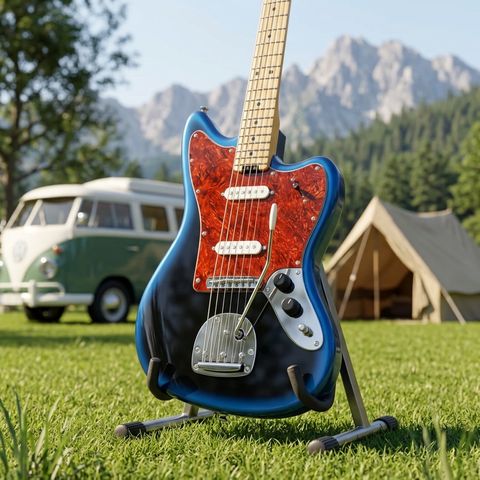
Product reference: GTST-03. Confirm the model’s neck joint directly; this photograph is not a sectional view of its construction.
Identify the joint in a bolt-on vs neck-through comparison
A bolt-on instrument has a separately made neck secured mechanically to the body. In a neck-through design, the neck’s structural section continues through the central body region, with body sections attached at the sides. Yamaha’s electric guitar anatomy guide illustrates this distinction and also separates the glued set-in neck category. A smooth-looking heel therefore does not, on its own, identify a neck-through guitar.
Neck-through also does not necessarily mean that the entire guitar is carved from one unbroken piece of timber. For example, ESP’s M-I NTB NT USA specification describes a three-piece laminated neck-through design and mahogany wings. That is a specific manufacturer’s construction example, not a Gusto specification or proof that every neck-through instrument uses the same materials.
Ask for the exact joint description, a clear rear view and, where necessary, a construction drawing. Opaque finishes and sculpted transitions can make photographs ambiguous. The wording on an approved specification should settle whether the instrument is bolt-on, set-in or neck-through; a salesperson’s general description of a “seamless feel” should not substitute for it.
Repairability means more than removing fasteners
The detachable-neck advantage has conditions
A removable neck can make certain repairs or replacement strategies more practical. It allows the neck and body to be handled as separate components, provided the work is appropriate for that instrument. However, “replaceable” is not the same as “any replacement will fit.” An exact matching part, suitable geometry and competent setup are still required.
Warmoth’s neck-fit guidance explicitly warns that neck-pocket dimensions are not universal and explains that pocket shape and scale compatibility matter. This is a useful counterexample to the assumption that two familiar-looking bolt-on guitars accept interchangeable necks. For an order, obtain a compatible part identifier rather than relying on the number of mounting screws.
Discuss pocket and heel dimensions, mounting pattern, fretboard overhang, scale geometry, string alignment and the bridge’s adjustment range. A neck that can physically enter a pocket may still be unsuitable for the intended bridge position. Do not enlarge holes, force a tight fit or assume that an online replacement description establishes compatibility. Ask the instrument or replacement-part manufacturer to confirm the complete match.
A continuous neck needs a different service plan
In a neck-through guitar, the neck is part of the central structure. It cannot be swapped as an independent bolt-on component during ordinary service. That does not mean every damaged neck-through instrument is beyond repair: a repair professional must assess the particular fault, access and cost. It does mean that a purchasing plan based on keeping interchangeable spare necks does not translate directly.
Ask which faults the proposed service arrangement covers, who evaluates them, and whether an instrument returns for repair or replacement. These are questions to resolve before purchase, not assumed warranty promises. Freight, inspection and setup can matter as much as the physical repair when the owner and service provider are in different regions.
Upper-fret access is a geometry test
Neck-through construction can allow a gradual neck-to-body transition, but the label does not measure how your hand will reach the highest frets. Cutaway depth, heel contour, body thickness, neck position and strap height all affect access. A carefully shaped bolt-on heel may work well for a particular player, while another instrument with a continuous neck may still place the body in the way.
Test a musical task rather than merely touch the last fret. Play a phrase above the twelfth fret, a bend at the highest position you regularly use, and a chord or double-stop involving the lower strings. Notice whether the palm hits the heel, whether the thumb must move abruptly and whether the guitar rotates while you reach. Repeat the passage standing, because a seated trial can hide a difficult transition.
Write down where the difficulty occurs. “The heel interrupts the move from fret fifteen to nineteen on the low strings” gives a supplier something specific to assess. “Neck-through is faster” does not identify a measurable need and can lead to a construction change that leaves the actual access problem unresolved.
Do not turn sustain language into an acceptance test
Manufacturers often associate construction methods with particular sound characteristics. Those descriptions can help explain their design intent, but they are not a controlled comparison of every available instrument. A complete guitar also has its own strings, bridge, frets, pickups, setup and individual resonances. The joint name alone cannot establish how long a particular note will remain useful in your playing context.
If sustain matters, define the note and the sound you need. Compare accurately tuned instruments through the same clean signal path, without a compressor or excessive gain masking the decay. Use comparable strings and action, and repeat several notes across the neck. Match listening levels so a higher-output pickup does not create an unfair impression of a stronger instrument.
A simple demonstration might record the same fretted note several times at a consistent attack, followed by a phrase that needs that note to ring. Listen for an abrupt decay or troublesome resonance in the passage. This is a practical sample comparison, not a laboratory isolation of the neck joint. Retain the recording and the setup conditions with any purchasing decision.
| Priority | Bolt-on question | Neck-through question |
|---|---|---|
| Future service | Is an exact compatible neck available? | Who assesses structural faults and what is the service route? |
| Playing access | Does this heel interrupt the required passage? | Do the contour and cutaway actually suit the hand? |
| Consistency | Are alignment and setup repeatable across samples? | Are the same setup and note-response checks repeatable? |
| Specification | Record pocket, mounting and scale compatibility. | Record central construction, materials and transition. |
Inspect a sample without creating a repair problem
Check visible alignment: the strings should follow their intended path along the fingerboard and sit appropriately over the bridge and pickups. Play every fret with a consistent attack and listen for faults. Photograph any joint-area gap, finish crack or irregularity and ask for an assessment; appearance alone does not distinguish a cosmetic issue from a structural one.
Do not tighten neck screws as a speculative quality check. Fastener type, seating and the maker’s instructions matter, and unnecessary adjustment can damage threads or alter the setup. Similarly, do not interpret a hidden joint under a solid finish by attempting to disassemble the instrument. Sample inspection should document a concern and identify who is qualified to resolve it.
Questions that prevent a misleading comparison
Is neck-through the same as strings through the body?
No. String-through-body describes a string anchoring route; neck-through describes the neck’s structural continuation. A specification can mention one without implying the other. Ask the supplier to identify the bridge arrangement and neck construction in separate fields.
Can an attractive rear stripe prove neck-through construction?
No. A contrasting finish or decorative timber can resemble a structural centre section. Use the approved construction description and supporting drawing, especially where opaque paint conceals the joint. Do not base a purchase on a visual guess.
Does a detachable neck eliminate setup work after replacement?
No. Even an approved compatible part requires inspection, alignment, relief, action and intonation checks appropriate to the instrument. Include that work in the service estimate rather than budgeting only for the component.
Compare the joint on complete models from the solid-body guitar range. If a different layout from the headless guitar category is also considered, record its joint separately rather than inferring construction from its outline.
Which construction fits the buying brief?
A touring player who values a defined replacement-neck strategy should investigate actual bolt-on part availability. A player prioritising a particular upper-register transition may prefer a specific neck-through sample after trying it. Neither preference removes the need to inspect the complete guitar. A retailer stocking both should explain those practical differences rather than label one method professional and the other entry-level.
For a product enquiry, identify the construction you want, the musical reason, required scale and fret count, and the service information you need. Compare the Gusto product families, then request a confirmed model-specific construction and sample plan. The strongest choice is the instrument whose geometry, sound and maintenance requirements have all been checked against the same brief.

Get Best Guitars
Join Gustoguitar.com Newsletter to get more information of electric guitars, classical guitars, and all kinds of guitars.


