

 By Gusto Guitar
Evaluate coverage, fit, support, and material behavior instead of buying by foam thickness alone.
Guitar gig bag padding should be evaluated as part of a complete carrier: fit, support, lining and the intended handling conditions all matter. A thick panel does not automatically protect every edge, and a soft lining does not prove impact performance. Buyers should ask where padding is located, how the instrument is restrained, and what evidence supports any protection claim. This guide provides a way to compare real bags without turning one advertised foam thickness into a universal quality score or presenting another manufacturer’s specification as a Gusto product fact.
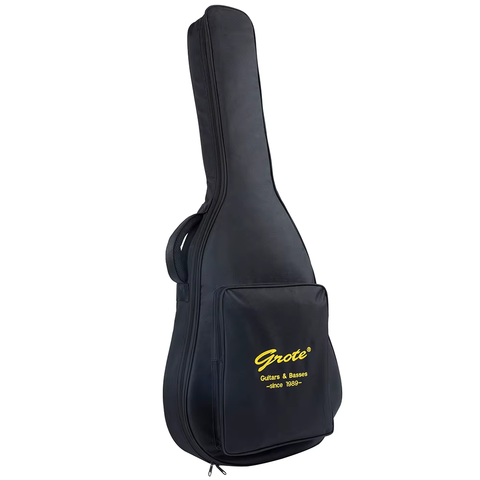
Evaluate guitar gig bag padding as a complete system
Place the intended guitar in the open bag and identify the areas that carry its weight. Look at the lower body edge, back, neck support, headstock or string-lock area, and any hardware projecting above the top. Padding should be evaluated where contact actually occurs. An impressive-looking front panel cannot compensate for a poorly supported lower edge or a sharp object pressing from a pocket.
Consider how the guitar sits when the bag is carried upright and when it is laid down. The load path can change with orientation. A bag that looks supportive on a table may let the instrument slide toward the bottom during carrying. Note these observations before comparing numerical padding descriptions, because a material specification without its location tells only part of the story.
Read thickness claims carefully
Ask whether a stated thickness applies to every panel or only a selected area. Clarify whether it describes the foam itself, a layered assembly, or an approximate finished panel. Compressed padding at a seam may behave differently from a flat central section. Do not assume a single number represents the entire bag, especially around corners, zipper tracks, and the base.
For example, Gator’s GBE-ELECT product page identifies a particular foam thickness for that named product. This is an example of a model-specific specification, not proof that every bag with the same nominal number provides equal protection. It also does not establish the padding used in any Gusto option. Request the actual construction details for the item being quoted.
Separate thickness from material behavior
Different padding materials can feel and compress differently even when their uncompressed thickness looks similar. Ask the supplier to describe the material and construction rather than offering a number alone. For a purchasing sample, compare how the padding supports the intended guitar under normal handling. Record the assessment as an observation, not as a laboratory impact rating.
Avoid trying to infer protection from squeezing a panel with your fingers. That may reveal an obvious soft spot or missing layer, but it does not recreate the loads of a fall or rough transport. If a supplier claims tested protection, request the test method, sample configuration, and result. The test should concern the assembled product and relevant instrument load, not merely a loose foam coupon.
Check coverage around the lower body
The bottom of a vertically carried bag deserves close attention because it supports the instrument’s weight in that position. Inspect the relationship between the lining, padding, seams, and any reinforced base. Look for a shape that supports the instrument without placing concentrated pressure on a vulnerable projection. A decorative exterior patch does not by itself reveal the structure underneath.
Check the body edges and corners as well as the broad front and back surfaces. An offset body or unusual horn can place contact in a different area from a conventional outline. Ask whether the bag is designed for that profile. Increasing the overall bag size may create unwanted movement rather than solving a local mismatch.
Evaluate neck support without making a clamp
If the bag includes a neck rest or restraint, check where it contacts the actual instrument. It should suit the neck’s position relative to the body and avoid forcing the guitar into an unnatural posture. A removable support can be useful only if its permitted positions and fastening method suit the intended use. Do not assume that a generic block fits every neck and body geometry.
A restraint should be assessed together with fit, not tightened as a substitute for fit. Check that it does not press against strings, finish, or hardware in an unintended way. Ask the maker how it is supposed to be used. If instructions are absent and the support position is doubtful, request clarification before carrying the instrument.
Inspect the lining and wear areas
A soft lining should be clean, securely attached, and compatible with the instrument’s finish under the intended conditions. Check seams and any rough areas that could rub during insertion. Pay attention to the path of the bridge, tuners, string ends, and strap buttons. These areas can create localized wear that is not obvious from an empty-bag photograph.
Ask whether the bag has dedicated reinforcement where hardware meets the lining. Do not interpret reinforcement as permission to leave sharp string ends exposed. Follow the instrument’s normal maintenance instructions and keep the interior free of loose items. A small object trapped between padding and finish can undermine an otherwise sensible protection arrangement.
Examine the opening and zipper route
The zipper opening should let the instrument enter without scraping or excessive twisting. Check that zipper hardware remains separated from the finish and that the closure can move freely with the guitar inside. A tight bag may compress padding exactly where clearance is needed. Repeatedly forcing the zipper closed is a fit problem, not evidence that the padding is holding the instrument securely.
Inspect stitching and transitions near the ends of the opening. These areas can combine load, bending, and abrasion during daily use. Ask how the opening is intended to be held while removing the guitar. A practical design should permit careful handling without requiring the user to balance the instrument while fighting the bag.
Include straps and pockets in the protection review
Carry the loaded bag in a controlled setting to assess balance and comfort. Observe whether strap adjustment changes how the guitar rests inside. Check handle and strap anchor areas for obvious construction concerns. Comfort and retention are part of useful protection because a bag that is difficult to carry may be knocked into doors or set down awkwardly.
Load accessory pockets only with the items you intend to carry, and check what lies behind them. Heavy tools or a bulky cable can create a pressure point. Use a separate compartment where the design provides one and follow the maker’s loading advice. A large pocket volume should not be treated as a reason to carry everything against the instrument.
Ask for evidence appropriate to the claim
A specification sheet can establish declared materials and dimensions. A sample can establish observable fit and construction. A documented test can support a defined performance claim under its stated conditions. These are different forms of evidence. Keep them separate so that a good visual sample does not become an unsupported promise of protection against drops, crushing, or airline handling.
If no protection test is available, describe the bag conservatively in your purchasing and sales records. State the verified construction and intended carrying use without inventing a rating. Avoid broad words such as maximum protection unless the underlying claim is defined. A transparent description is more useful than a dramatic phrase that nobody can explain or reproduce.
Compare samples with a consistent record
Use the same instrument and observations for each candidate. Record fit, support location, padding coverage, opening clearance, carrying balance, and accessory separation. Photograph the same areas so differences remain understandable later. If a supplier changes the padding material or panel construction after approval, request a revised sample or suitable evidence rather than silently accepting the old reference.
For wholesale orders, connect the approved sample to a product revision and packing specification. Decide how production consistency will be checked before dispatch. A useful inspection record describes the actual construction features to verify; it does not rely only on pressing a panel and declaring it thick enough. Keep replacement and care information with the product record.
Compare the current bag and case options using the support and fit checks above. If the instrument has a compact outline, review the headless guitar range and confirm the bridge and neck support rather than assuming a conventional bag fits.
Make the final choice around the actual guitar
| Feature | Question to ask | Evidence needed |
|---|---|---|
| Thickness | Where is it measured? | Panel-specific specification |
| Coverage | Are edges and base protected? | Interior sample inspection |
| Support | Does it align with this neck? | Loaded fit trial |
| Material | What is the actual construction? | Supplier material description |
| Performance | What conditions were tested? | Relevant assembled-product test |
Ask which current bag options suit the intended model in the Gusto Guitar product range. Provide dimensions and explain the carrying route. Request verified padding details, a sample where appropriate, and precise limits on any protection claim. No universal thickness can replace that combination of fit, support, construction, and evidence.
A good decision may favor a bag with a more suitable shape and support layout over another with a larger advertised number. It may also show that a gig bag is not the right solution for a particular journey. The goal is to choose and describe protection that can be justified, rather than to make every instrument fit a simple thicker-is-better rule.

Get Best Guitars
Join Gustoguitar.com Newsletter to get more information of electric guitars, classical guitars, and all kinds of guitars.


