

 By Gusto Guitar
Build a range around customer needs, clear model differences, and stock you can support.
An electric guitar product range works best when every model serves a clear customer need and has a configuration you can verify. More listings do not necessarily create more useful choice. If several models differ only in color while a common customer need remains uncovered, the catalog may look large but perform poorly. Range planning starts with the people you intend to serve, then connects their needs to verifiable configurations, service requirements, and a manageable stock commitment. The method below is a proposed planning process, not a description of Gusto Guitar’s current inventory or a promise that every configuration is available.
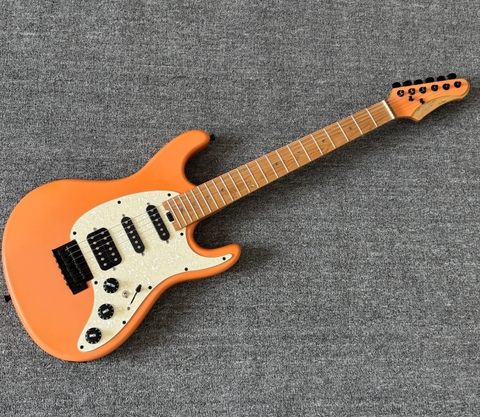
Define customers for your electric guitar product range
Write down who makes the purchasing decision and how the guitar will be used. A beginner buying a first complete setup, a touring musician seeking a compact backup, and a retailer replacing a familiar bestseller bring different questions. Describe their practical needs without assuming that a musical genre determines one correct instrument. Comfort, pickup function, bridge maintenance, and access to suitable strings may matter more than a broad label such as rock guitar.
Separate customer groups that need different buying support. Someone comparing a first six-string instrument may need a simple explanation of controls and an accessory list. An experienced seven-string buyer may ask about scale length, string clearance, and the delivered tuning. If those customers share one generic product description, both may struggle to find the facts needed to choose. Planning the information alongside the instrument prevents this problem.
Give every proposed model a job
Create a short role statement for each candidate. Examples include an accessible first electric guitar, a familiar fixed-bridge option, a compact instrument for a specific player, or a contrasting pickup configuration. These are planning roles rather than claims about any actual model. If two candidates have the same role, compare their verified differences before stocking both. You may find that one model in two finishes serves demand better than several nearly identical constructions.
Use broad instrument families only as navigation aids. Before publishing six categories, verify that six meaningful families actually exist in the available product data. Do not create a category merely to reach a target number, and do not treat basses as extended-range guitars. A family name should describe an understandable buying choice; a model code belongs in the model record rather than serving as the only explanation of a whole category.
Build a configuration matrix
List the features that can change the purchasing decision: body construction, string count, scale length, pickup layout, switching functions, bridge system, neck measurements, handedness, and included protection. Mark unknown values explicitly. This reveals genuine gaps and duplicate propositions without relying on product photographs. Two similar silhouettes may contain different circuits, while two different colors may be exactly the same specification.
Fender’s official model comparison illustrates that one familiar body family can contain different neck profiles and configurations. The planning lesson is to compare specified features within a family. Those Fender examples do not establish that Gusto offers the same necks, electronics, or model variants, and they should not be copied into Gusto product records.
Choose a small set of decision fields rather than an endless spreadsheet. A feature deserves a column when it changes customer suitability, purchasing cost, servicing, or the accuracy of the product page. Keep cosmetic options in a linked variant record where possible. That makes it easier to see whether the range contains useful functional variety or simply many combinations of the same components.
Control the number of stock combinations
A model, finish, handedness, and accessory bundle can each create a different sellable combination. Multiply proposed options before approving the range. For a hypothetical plan, three models in three finishes already create nine combinations before left-handed versions or case bundles are considered. This is arithmetic for planning, not a recommended minimum order or a statement of supplier stock.
Set a limit based on your ability to buy, describe, inspect, store, and support the range. Each additional combination needs accurate photographs and a reliable stock record. Avoid adding variants merely because a supplier can quote them. A variant should address evidence of demand, provide an intentional presentation choice, or support a documented commercial test. Otherwise, it may divide attention and stock across too many slow-moving items.
Plan depth as well as breadth
Breadth means the number of distinct needs you cover; depth means how much stock or choice supports each need. A new retailer can overinvest in breadth and have too little availability in the configurations customers actually request. Start by identifying which roles are core, which are experimental, and which can be quoted rather than held. Confirm the supplier’s current replenishment arrangements separately instead of assuming that a catalog listing means immediate availability.
Use actual inquiries, sales records, and customer feedback where available. Keep the period and sample size visible. Three requests from one customer are different evidence from repeated purchases across many accounts. If reliable history does not exist, label the opening range as a trial and decide in advance what observations will justify expansion. This prevents guesses from turning into permanent purchasing rules.
Include service and accessory compatibility
A range is easier to support when replacement strings, compatible cases, adjustment tools, and component identifiers are documented. This does not mean every instrument must share the same parts. It means that differences should be intentional and supportable. A special bridge may add a useful proposition, but the retailer also needs the correct operating instructions and a route for identifying replacement parts.
Record case fit by actual dimensions rather than broad body-style language. Verify whether a removable tremolo arm, adjustment wrench, or other accessory is included. Keep bundle contents separate from photographs of optional accessories. A customer should be able to understand what arrives in the carton without interpreting a staged image. These checks improve both range planning and the accuracy of subsequent product pages.
Approve a reference before expanding variants
For each selected construction, agree a specification and assess a representative sample. Record which aspects the sample approves and which remain subject to separate confirmation. A natural-finish sample cannot establish every opaque color match, and a six-string reference cannot approve the fit and setup of a different seven-string configuration. Treat changes according to their actual effect rather than assuming that a shared model name makes them minor.
Keep sample findings connected to range decisions. If a proposed model requires a service capability you do not have, reconsider its role or arrange suitable support before increasing quantities. If two configurations prove too similar for your customers to distinguish, simplify the opening range. Removing a weak candidate at this stage is a useful decision, not a failure to build a sufficiently large catalog.
Make the website follow the product logic
Use category pages to explain the meaningful differences between families, then use detail pages to document each model. Titles should combine an understandable product name with a model identifier when useful. Avoid creating multiple competing pages that repeat the same specifications under different color keywords unless the site genuinely needs separate variant pages. Keep links between buying guides, families, and products relevant to the decision being discussed.
Prepare a required-content checklist for every model: verified configuration, dimensions where needed, accurate images, included items, current inquiry route, and unresolved facts. Do not use a strong family description to conceal missing model details. Review the Gusto Guitar product range as a starting point, then request the current specification for each candidate rather than inferring details from another brand’s page.
Map the solid-body range and the headless guitar category against separate customer needs. Keep a distinct role for each family instead of expanding the catalog only through color variations.
Review the range with explicit decisions
| Planning question | Useful record | Decision supported |
|---|---|---|
| Who is the buyer? | Customer need and buying situation | Relevant product role |
| What makes it different? | Verified configuration matrix | Avoid duplicate models |
| How many combinations? | Model and variant count | Manage stock complexity |
| Can it be supported? | Parts, case fit, and instructions | Service readiness |
| Did the role work? | Review observations and actions | Retain, revise, or remove |
Choose a review period suited to your business and compare the results with the original role statements. Look at inquiries that did not become orders as well as sales. Record whether the obstacle was missing information, an unsuitable configuration, availability, price, or a service concern. A low-selling model may need a clearer description, but it may also occupy a role your customers do not need.
Finish each review with a concrete action: retain, improve information, change the bundle, test a variant, reduce stock, or remove a duplicate. Keep the reasoning with the model record so the next review does not restart from memory. A focused electric guitar range can grow over time while remaining understandable, inspectable, and useful to the customers it was built to serve.

Get Best Guitars
Join Gustoguitar.com Newsletter to get more information of electric guitars, classical guitars, and all kinds of guitars.


