

 By Gusto Guitar
A practical supplier checklist for checking evidence, production control, and order readiness before buying electric guitars.
An electric guitar supplier should be evaluated on evidence that it can consistently deliver the instrument agreed in your order. A clear answer about a pickup, a documented sample revision, or an honest limit on customization can be more useful than a broad promise of premium quality. This guide explains how to compare suppliers using evidence you can review and repeat. It provides a purchasing framework, not a ranking of factories or a statement of Gusto Guitar’s current production capacity.
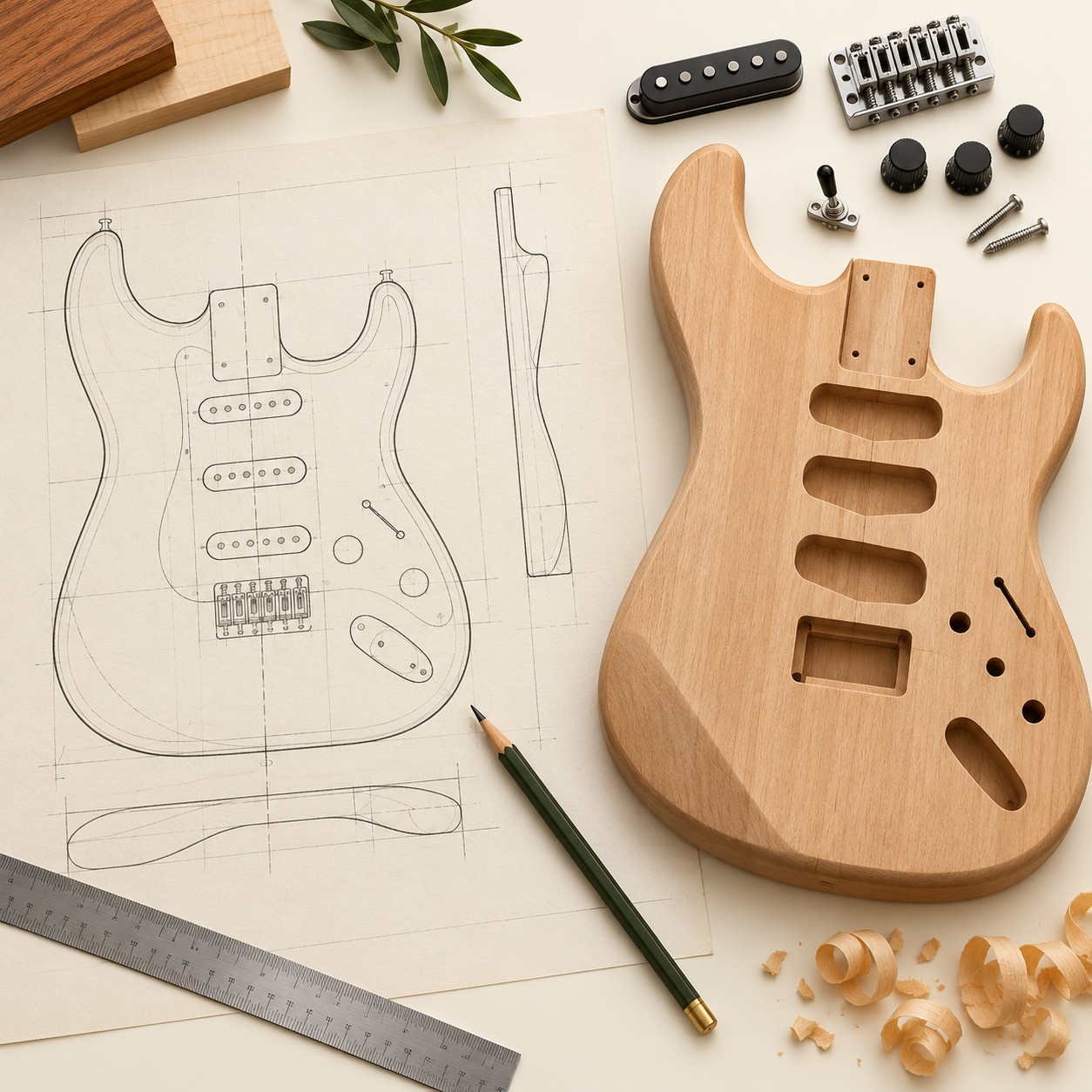
Evaluate an electric guitar supplier against your order
Write a short purchasing brief before contacting suppliers. Define the intended customer, instrument family, target configuration, expected quantity, and destination. Separate essential requirements from preferences. A store supplying beginners may prioritize consistent setup and replacement parts, while a specialist retailer may need unusual pickup combinations or extended-range instruments. A supplier suitable for one brief may be unsuitable for another without being a poor business.
Use the same brief for every candidate. If one quotation includes a case and another includes only a carton, the unit prices are not directly comparable. Record which assumptions are confirmed, which remain open, and which items were substituted. This prevents a low headline price from winning a comparison that quietly excludes important work.
Establish who is responsible for your order
Ask for the business name that will appear on the quotation, purchase order, and commercial documents. Clarify whether the contact represents a manufacturer, a trading company, or a business that combines both roles. These are different operating models, not automatic quality grades. The important question is who controls specifications, approves changes, performs final checks, and handles a problem after delivery.
Where practical, ask to see the relevant operation through an arranged visit or a focused live walkthrough. Request an explanation of how your proposed instrument moves from component selection to final packing. A general factory video may provide context, but it does not establish that the specific quoted model is made there or that the same process will be used for your order.
The International Trade Administration’s due diligence guidance treats partner assessment as an ongoing activity. Apply that principle to guitar purchasing: keep your supplier file current when the order scope, business contact, or production arrangement changes. The checklist below is a proposed buyer workflow, not a certification system.
Turn catalog descriptions into controlled specifications
Request one agreed specification sheet for each model. Describe body construction, neck joint, scale length, fret count, pickup layout, control functions, bridge type, finish, and included accessories. Keep material descriptions precise. A maple neck does not prove a maple body; a decorative top does not establish the thickness or construction of the underlying wood.
Ask the supplier to identify every unresolved item. If the listing title and specification table disagree, request a corrected document rather than choosing whichever version sounds preferable. Record the revision date and the person approving it. The supplier’s response reveals whether it can manage configuration, not merely repeat a listing.
| Evaluation area | Evidence to request | Decision question |
|---|---|---|
| Model definition | Dated specification and marked photographs | Do both sides mean the same instrument? |
| Repeatability | Sample record and change approval process | Can the approved configuration be reproduced? |
| Inspection | Checklist, measurement method, and report example | Will defects be identified before shipment? |
| Delivery planning | Order milestones and dependencies | What must happen before goods are ready? |
| After-sales support | Written reporting and remedy process | Who does what if a problem appears? |
Use a sample to test the supplier’s process
Approve the sample specification before ordering the sample. Otherwise, the delivered instrument may be judged against expectations the supplier never received. Keep the sample identification, specification revision, photographs, test notes, and requested changes together. State whether approval concerns appearance only, playability only, or the complete production configuration.
A sample is also a communication test. Send a short list of measurable observations and ask for a point-by-point reply. A useful reply identifies the cause, proposed correction, effect on the specification, and verification method. A vague assurance that the next order will be better leaves you with no objective way to check improvement.
Distinguish a demonstration sample from an approved production reference. If a particular component cannot be repeated in quantity, establish the permitted alternative before approval. Do not assume that an impressive one-off instrument demonstrates repeatable supply of every finish and hardware combination in your proposed range.
Ask how quality is measured
Request an inspection plan that distinguishes cosmetic checks, dimensional checks, functional tests, and playing assessment. Ask which checks cover every instrument and which use a selected sample. If sampling is proposed, agree how instruments are selected and what happens when a checked unit fails. A percentage stated without a selection method or decision rule is incomplete.
Setup requirements need a defined test condition. Fender’s factory setup guidance explicitly relates its measurements to the original string gauges and allows for application differences. Use this as a reason to specify your own approved strings, tuning, measurement points, and targets. Fender’s figures are not Gusto acceptance limits and should not be copied into a purchase specification without model-specific agreement.
Ask to see a completed report with actual readings or observations, not just a blank checklist. A useful report lets you identify the instrument inspected and understand how a conclusion was reached. Photographs can support the report, but an attractive picture cannot verify a control’s electrical function or the accuracy of fretted notes.
Evaluate delivery promises through dependencies
Instead of asking only for a delivery date, ask what starts the lead-time clock. Possible dependencies include specification approval, material confirmation, sample sign-off, artwork approval, and packaging availability. Request a milestone plan that identifies who supplies each input. Do not treat an estimate given before those inputs are fixed as an unconditional commitment.
Ask how the supplier reports delays and changes. You need to know when a component becomes unavailable, whether a substitute changes appearance or function, and whether the order can proceed without your written approval. A practical change-control process is more valuable than a promise that delays never occur.
For a new range, consider a manageable pilot order whose size reflects your business needs and the supplier’s confirmed terms. This is a purchasing option, not a claim that any particular minimum quantity is available. Use the pilot to assess specification consistency, inspection reporting, packaging, and communication through the complete delivery cycle.
Compare the whole purchasing offer
Build a comparison that includes the instrument, accessories, packaging, inspection work, and any separately quoted development items. Clarify what is included and what requires another quotation. Keep current written commercial terms with the technical specification so that a later revision cannot silently change the scope.
Northern Ireland’s official business information service advises buyers to consider quality, reliability, delivery, and written quotations when choosing overseas suppliers. For guitar orders, extend that general principle into a model-level comparison: the cheapest offer may cover a different bridge, case, setup process, or packing arrangement. Resolve those differences before deciding which offer represents better value.
Check support before it is needed
Ask what information is required to report a defect: instrument identification, photographs, video, measurements, or an inspection report. Clarify the reporting route and how the supplier decides between advice, replacement parts, repair, or another agreed remedy. These questions identify the process; they do not establish a warranty unless it is confirmed in the order terms.
Discuss parts compatibility as well as parts availability. A bridge or tuner with a similar appearance may use different mounting dimensions. Ask which component identifiers or measurements should be retained. For a retailer, a clear record can prevent a straightforward service request from becoming an extended search for an incompatible replacement.
Make a decision with open items visible
Create a short decision record for each candidate. Mark every requirement as evidenced, awaiting evidence, or outside the proposed scope. Do not hide a critical unresolved issue inside an average score. A supplier that answers most questions well may still be unsuitable if an essential component or inspection requirement remains unconfirmed.
For example, imagine two offers with comparable appearance and price. One includes a controlled specification but lacks an agreed inspection method; the other supplies a detailed inspection proposal but cannot confirm the quoted hardware. Neither gap disappears because the overall presentation is strong. Ask for the missing evidence, then compare the corrected offers. This is a hypothetical example, not a description of Gusto or another supplier.
Use the solid-body electric guitar category to define a concrete model brief. If the proposed range includes other body constructions, consult the solid body vs semi-hollow comparison before treating two quotations as equivalent.
Questions buyers often ask
Does being a factory automatically make a supplier better?
No single business label answers the purchasing question. Evaluate control over the proposed order, traceability of specifications, quality evidence, communication, and the responsibility accepted in writing. A business model is relevant context, while execution against your requirements is the practical test.
Is one approved sample enough?
An approved sample is an important reference, but it does not replace production checks. Keep it tied to a specification revision and compare the production order against that agreed reference. Repeat the approval process when a material change affects the instrument you intend to buy.
What should I send with an initial inquiry?
Start with your intended range, required configurations, quantity assumptions, destination, and open technical questions. Review the Gusto Guitar product range to identify relevant instrument families, then ask for current model-specific details. Product availability, customization, quantities, and delivery terms should be confirmed for the actual inquiry.

Get Best Guitars
Join Gustoguitar.com Newsletter to get more information of electric guitars, classical guitars, and all kinds of guitars.


