

 By Gusto Guitar
Look beyond the compact silhouette: compare tuning hardware, string compatibility, ergonomics, setup and service support before buying a headless electric guitar.
A headless guitar can look simple because it removes a familiar part of the instrument. Buying one still requires careful questions. Where are the strings anchored? How are they tuned? Which replacement strings fit? Can you reach the controls comfortably, and can a technician obtain a small replacement part when you need it?
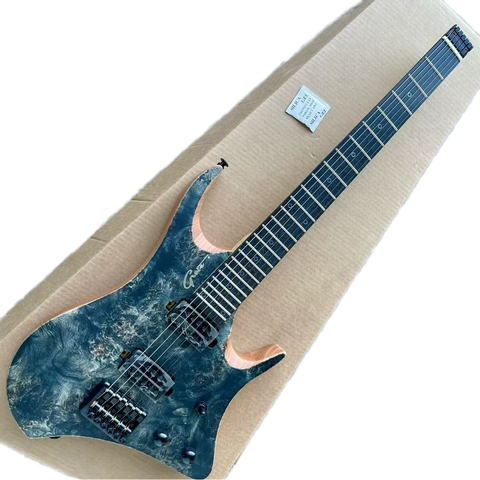
A headless electric guitar example from Gusto Guitar. Bridge and string compatibility must be checked for the specific model.
This guide turns those questions into a practical inspection. It is intended for players comparing their first headless guitar and for buyers approving a sample. It does not assume that every headless design is lightweight, multiscale or fitted with the same bridge.
1. Identify the actual tuning and string-lock arrangement
On many headless electric guitars, tuning is performed at the body end while strings are secured near the end of the neck. The details depend on the hardware. A product photograph showing the missing headstock does not tell you how the clamp works, what tools it needs or how much adjustment range the tuner provides.
Ask for close photographs of both ends of one string path. You should be able to identify the tuner, saddle, anchor or clamp, and the hardware used for adjustment. Then request the operating instructions for that exact system. A generic headless-guitar video is not enough if it shows different components.
For example, Strandberg’s EGS Rev 7 string-changing guide describes a particular tuner preparation and string-lock procedure. It is useful evidence that the sequence matters; its tool sizes and instructions should not be transferred to an unrelated bridge.
2. Separate four specifications that often get bundled together
Headless construction
This concerns the absence of a conventional headstock and the way the strings are secured and tuned. It does not, by itself, specify the number of strings, the neck profile or the body’s internal construction.
Multiscale or fanned frets
A headless guitar may have parallel frets or a multiscale layout. If the frets are fanned, request the scale length at each end of the fretboard and the position of the neutral fret. A listing that gives only one length needs clarification before you can compare it with a conventional-scale instrument.
Fixed bridge or tremolo
Confirm whether the bridge moves and which adjustments the manufacturer provides. Do not infer a tremolo from a modern appearance, or a fixed bridge from the lack of a visible arm in one photograph. Ask for a demonstration using the actual sample.
String count and intended tuning
Six-, seven- and extended-range designs should be evaluated separately. Record the intended tuning and proposed string set before discussing neck feel or low-string response. A suitable choice for one tuning is not automatically a suitable choice for every lower tuning.
3. Verify replacement-string compatibility before paying
Ask whether the hardware accepts ordinary single-ball strings, requires another end format, or has specific restrictions. Also confirm the maximum usable string diameter at both the tuner and the neck-end lock. These are questions for the exact hardware supplier; a general statement that “standard strings fit” may not cover the heavy set you intend to use.
Request a short demonstration with the proposed string gauge. Ideally, it should show a string being installed, secured, brought to pitch and checked without cutting away the steps around the clamp. This reveals more than a beauty shot of the bridge.
Keep the supplied tools and instructions with the instrument. Before ordering multiple guitars, check whether the same components and tool requirements will be used across the batch. If a hardware revision changes, ask for updated instructions rather than treating the old demonstration as proof of compatibility.
4. Test comfort in the positions you actually use
Standing: balance and tuner clearance
Use a strap and let the guitar settle into a natural playing position. Check whether you must support the neck continuously, whether the body rotates away from you and whether the tuners press against your hand or clothing. Record what you experience instead of assuming that a shorter instrument must balance well.
Seated: leg support and picking-arm position
Try your normal seated position and any alternative position you expect to use. Does the lower body contour stay on the leg? Is the picking arm relaxed? Can you reach the last frets without repositioning the instrument unexpectedly? A compact outline can suit one posture better than another.
Controls: reach without accidental contact
Play a normal phrase, change pickup settings and adjust the volume while holding the instrument normally. Then check the tuner access again. A control that is easy to reach on a desk may be awkward when the guitar is strapped on. This is a good reason to evaluate a complete sample rather than selecting individual specifications from a spreadsheet.
5. Compare scale, neck and setup as a system
A comfortable headless guitar needs more than an appealing fret layout. Ask for the neck width and thickness at agreed positions, fret count, supplied strings and setup information. If you are comparing two samples, document the differences before attributing one instrument’s feel entirely to being headless.
Changing strings or tuning can require another setup check. Strandberg’s technical note on string gauges and tuning identifies neck relief, intonation and tremolo balance as relevant checks on its instruments. The practical buying lesson is to approve a sample in the tuning you intend to use, with a compatible string set, rather than judging a different setup and assuming it will translate unchanged.
Do not demand a universal “perfect action” number. Agree how the instrument will be measured and ask a qualified technician to assess whether the setup suits the playing style. Low string height, clean response and forceful picking can involve trade-offs that should be discussed on the actual guitar.
6. A repeatable sample test
- Record the starting condition. Photograph the bridge and string locks, note the tuning and strings, and inspect for shipping damage before making adjustments.
- Tune using the correct instructions. Confirm that the tuners operate smoothly and remain accessible in playing position. Do not force a component that reaches its adjustment limit.
- Play across the fretboard. Include open strings, chords, notes high on the neck and the techniques you normally use. Write down where an issue occurs rather than simply recording “buzz.”
- Check every electrical position. Operate the pickup selector and controls through their available settings. Record the result without assuming a switch diagram from another model applies.
- Recheck after normal playing. If the pitch changes, ask the technician to identify the cause before concluding that the headless concept or the entire model is defective.
- Repeat with the intended packing. Verify that the guitar and hardware have clearance inside the chosen bag or case and that accessories are secured separately.
This is a receiving and comparison procedure, not a substitute for the manufacturer’s maintenance instructions. Its value is consistency: each sample is checked under the same conditions, and a problem can be described precisely enough for the supplier to investigate.
7. Ask about small parts and long-term service
A missing clamp screw or damaged tuner can matter more than a minor difference in finish. Before approval, request the hardware model or revision, a parts diagram if available, and the method for ordering replacement pieces. Find out which components are proprietary and which dimensions a local technician needs to identify compatible parts.
For a wholesale order, clarify what happens if the bridge supplier changes during production. The useful question is whether the confirmed sample specification includes the hardware, not merely whether the replacement is described as “equivalent.” Record any approved substitution and check the next sample against it.
Also ask which adjustments owners are expected to perform and which should be handled by a technician. Written instructions and an identifiable contact route are easier to use later than a verbal promise made during an initial enquiry.
8. Travel suitability: measure the packed instrument
Do not buy solely on the assumption that a headless guitar will qualify as cabin baggage. Measure the instrument in its actual protective bag or case, including handles and protruding parts, then check the carrier’s current rules for the journey. A compact guitar and an oversized case can still be an inconvenient combination.
Check the support around the neck end and the clearance around body-end tuners. The guitar should not rely on a vulnerable component as a packing support. If the seller proposes a universal bag, request the internal measurements and a photograph showing how this particular guitar sits inside it.
9. What belongs on your enquiry sheet?
- String count, target tuning and proposed string gauge.
- Scale length, or both endpoint lengths for a multiscale design.
- Neck measurements and fret specification.
- Bridge and string-lock identification, compatible strings and supplied tools.
- Pickup configuration and the functions of each control position.
- Actual sample weight and packed dimensions.
- Replacement-parts route, setup instructions and approved sample specification.
These details help turn an attractive listing into a clear purchase decision. If a title, photo and specification disagree, ask which one describes the sample that will be supplied. Do not fill the gaps by borrowing details from a similar-looking guitar.
Questions before choosing your first headless guitar
Are all headless guitars lighter than conventional guitars?
Request the actual weight and test the balance. Removing a headstock does not tell you the mass of the body, bridge or the complete instrument.
Do all headless guitars require special strings?
No single rule should be applied to every system. Confirm the string-end format, gauge compatibility and installation procedure for the hardware fitted to the guitar you are buying.
Is a multiscale fretboard compulsory?
No. Check the specific model’s fret layout and scale dimensions. Treat headless construction and multiscale construction as separate choices.
Should I choose a fixed bridge or a tremolo?
Start with whether you use pitch modulation in your playing, then consider setup and tuning changes. Ask for the adjustment instructions and compare samples equipped with the system you actually intend to use.
Make the hardware and playing fit part of the decision
A good shortlist answers three questions clearly: does the instrument fit your playing position, does its hardware support your strings and tuning, and can it be maintained after delivery? Once those are settled, finish, appearance and other options become easier to choose.
Browse Gusto Guitar’s headless electric guitar category and seven- and twelve-string category for relevant configurations. Send a model enquiry with your intended tuning and required specification so the current hardware, compatibility and sample details can be confirmed.

Get Best Guitars
Join Gustoguitar.com Newsletter to get more information of electric guitars, classical guitars, and all kinds of guitars.


