

 By Gusto Guitar
Distinguish the traditional single-coil design from its housing and modern variants, then compare noise, response and physical compatibility on the actual instrument.
Compare P90 vs humbucker pickups through their specific designs, circuits and complete instruments under matched listening conditions. A seller may use P90 to describe a sound, a familiar cover or a particular internal design, while another listing combines P90 and humbucker in the same title. Resolve that identity question first. Once you know what the pickup actually is, you can make a useful comparison of the playing response, noise behaviour and installation requirements.
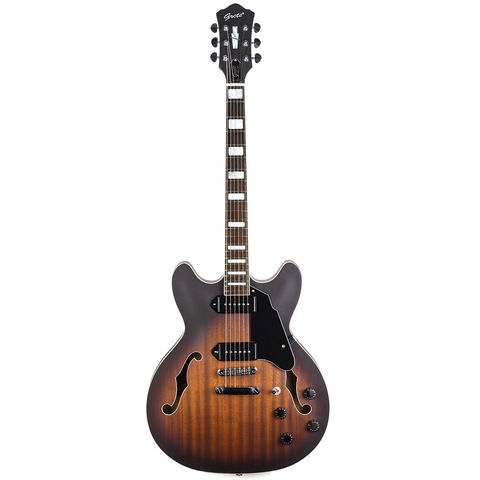
Gusto Guitar GT335-04 reference image. This exterior view does not establish a pickup’s internal coil construction; confirm the current model specification.
Compare P90 vs humbucker pickups through actual construction
Seymour Duncan’s pickup-type guide identifies P90s as single-coils and distinguishes them from multi-coil hum-cancelling designs. A familiar wide cover does not turn the traditional P90 into a conventional side-by-side humbucker.
That distinction matters when a title says P90 humbuckers without explanation. It may be inaccurate wording, or it may refer to a particular hum-cancelling variant. Ask for the manufacturer and model, internal design description and applicable wiring information rather than choosing an interpretation that sounds convenient.
Keep the three questions separate: what is inside the pickup, what size and shape it occupies, and what tonal intention the maker describes. A marketing phrase can address one of those questions while leaving the other two unanswered.
Modern variants make appearance a poor identification method
Seymour Duncan’s P90 Stack is a manufacturer-documented example of a hum-cancelling design in a P90-style package. It shows why a soapbar appearance alone cannot prove that a pickup is a traditional single coil.
The reverse distinction also matters. The company’s Phat Cat description identifies a single-coil P90 design housed for a humbucker retrofit. A humbucker-shaped exterior therefore does not by itself prove conventional humbucker internals.
These examples describe Seymour Duncan products, not the pickups in any Gusto guitar. Their purpose is to demonstrate why a photograph or contradictory marketplace title should lead to a specification question, not a confident assumption.
Understand what hum-cancelling does and does not promise
A traditional single-coil P90 does not use the ordinary two-coil hum-cancelling arrangement of a conventional humbucker. That makes environmental interference an important part of the audition. It does not mean every noise in a recording is caused by the pickup design.
A humbucker also does not guarantee a completely silent guitar. The full system includes wiring, cables, electronics, gain and the surroundings. Diagnose a particular problem with those conditions recorded rather than treating the pickup category as a complete explanation.
If a pair of P90s is advertised as hum-cancelling in its combined setting, confirm the actual pairing and wiring. That statement would concern a specific operating position, not necessarily either pickup alone. Do not transfer it to an unrelated pair merely because both pickups have the same general type name.
Run a noise test that answers a real playing question
Use the same amplifier, cable and basic settings for both candidates. With the strings controlled, listen to the background noise in each selector position. Then repeat the test using the gain level appropriate to your material.
Note the location and any equipment nearby. If noise changes when the guitar’s orientation changes, record that observation rather than editing it out of the demonstration. The practical question is whether you can use the instrument comfortably in your intended setting.
Distinguish electrical hum from squealing or other unwanted feedback during amplified playing. They may need different investigation. A single label such as noisy can conceal several unrelated symptoms and lead to the wrong purchase or repair decision.
Compare response without turning tendencies into a ranking
P90s and humbuckers are often described with familiar tonal adjectives, but those words do not predict every model. A comparison is more useful when it identifies the exact pickups and the musical task: a chord passage, a lightly played line or a driven rhythm figure.
Match the listening level sensibly and keep the initial amplifier setting documented. Listen to note separation, the attack you produce and how the sound changes as you reduce the guitar’s volume. The pickup that is louder in the first clip is not automatically the better choice.
Then use accompaniment. A sound that is attractive alone may occupy a different space in the complete arrangement. If one guitar needs a modest amplifier adjustment to work, test whether that adjustment is practical for the rest of the set rather than dismissing it immediately.
Use a focused comparison record
| Question | Evidence to collect | Common mistake |
|---|---|---|
| Pickup identity | Exact model and internal design description. | Classifying the pickup from its cover alone. |
| Noise | Same-location tests for each selector position. | Assuming hum-cancelling means the whole rig is silent. |
| Musical response | Comparable clean and driven passages at sensible levels. | Treating extra volume as superior tone. |
| Physical fit | Housing, mounting, depth and adjustment requirements. | Assuming all soapbars or humbucker-sized models interchange. |
| Circuit | Lead identification and the intended control diagram. | Expecting functions not supported by the actual wiring. |
Check dimensions before proposing a replacement
Housing style and mounting arrangement matter independently from the pickup’s electrical design. Ask for a dimension drawing and compare it with the guitar, including depth and adjustment clearance. The phrase humbucker-sized is not a substitute for checking a particular installation.
Even the P90 Stack example above notes a depth consideration for its own design. That is a useful reminder to inspect more than the length and width visible from the front. Do not approve irreversible routing or other alterations until the complete installation has been assessed.
If a technician will perform the work, agree on the proposed part and intended functions first. Keep the original parts and specification where appropriate. A clear brief prevents a pickup change from quietly becoming a larger and more expensive modification project.
Do not select only from a resistance number
A listed DC resistance is a measurement, not a complete description of output or tone. Seymour Duncan’s P90 Stack page explains that wire and coil details contribute to that reading, while other design factors also affect output. Comparing unlike designs solely by resistance can therefore create a misleading ranking.
Ask for the exact model and intended use, then listen to a relevant demonstration. Avoid assuming that a higher number means a more professional pickup, more usable gain or a better match to the other position in the guitar.
Also separate pickup height and setup from the purchasing description. If a sample seems poorly balanced, have it assessed according to the maker’s guidance rather than deciding immediately that the entire pickup family is unsuitable.
Resolve ambiguous supplier wording before publication
For a website or repeat order, do not preserve a phrase such as P90 humbucker merely because it appears in the source title. Record it as a question. Request confirmation of whether the supplied part is a traditional P90, a hum-cancelling variant, a humbucker-sized single coil or another identified design.
Update the customer description only after that answer is established. Avoid promising a branded pickup when only an unbranded type has been confirmed. A visually similar part is not proof of manufacturer, model or construction.
For later substitutions, recheck the noise behaviour, physical fit and operating controls as well as the public wording. An unchanged guitar model name does not establish an unchanged electrical specification.
Keep the sample approval reproducible
Retain a short recording of the approved sample with pickup positions, guitar controls, amplifier settings and any processing named. Include a quiet passage with rests as well as sustained playing. A recording that contains only loud notes can conceal whether background noise will interrupt softer material.
If the instrument will be used for both rehearsal and recording, evaluate both situations. The acceptable compromise may differ when there is a long exposed pause rather than continuous accompaniment. Write down that requirement before ordering so a supplier demonstration can address it directly.
Questions that help settle the choice
Is every soapbar pickup a traditional P90?
No. The housing is not conclusive evidence of the internal design. Obtain the exact identification.
Can a P90-style pickup fit a humbucker location?
Some specific models are designed for that purpose. Confirm dimensions and mounting for the actual guitar rather than generalizing from one retrofit example.
Which is right for my music?
Choose the actual pickup and guitar that provide the response and manageable noise you need under realistic conditions. A category name cannot replace that audition.
Explore Gusto Guitar’s semi-hollow guitars and solid-body range, then request confirmed pickup construction and switching details for the model you are considering.

Get Best Guitars
Join Gustoguitar.com Newsletter to get more information of electric guitars, classical guitars, and all kinds of guitars.


