

 By Gusto Guitar
Control artwork, placement, sample approval, and pack contents before production.
Private-label guitar branding depends on authorized artwork, controlled placement and a clear approval record for both the instrument and its packaging. The order needs a clear agreement about which artwork is authorized, where it appears, how it is reproduced, and which packaging version belongs to the instrument. A small ambiguity can be repeated across a whole batch. This guide focuses on artwork and packaging control, not hardware customization, trademark clearance, or a promise that Gusto offers every branding method discussed. Confirm actual capability and current commercial terms for the proposed order.
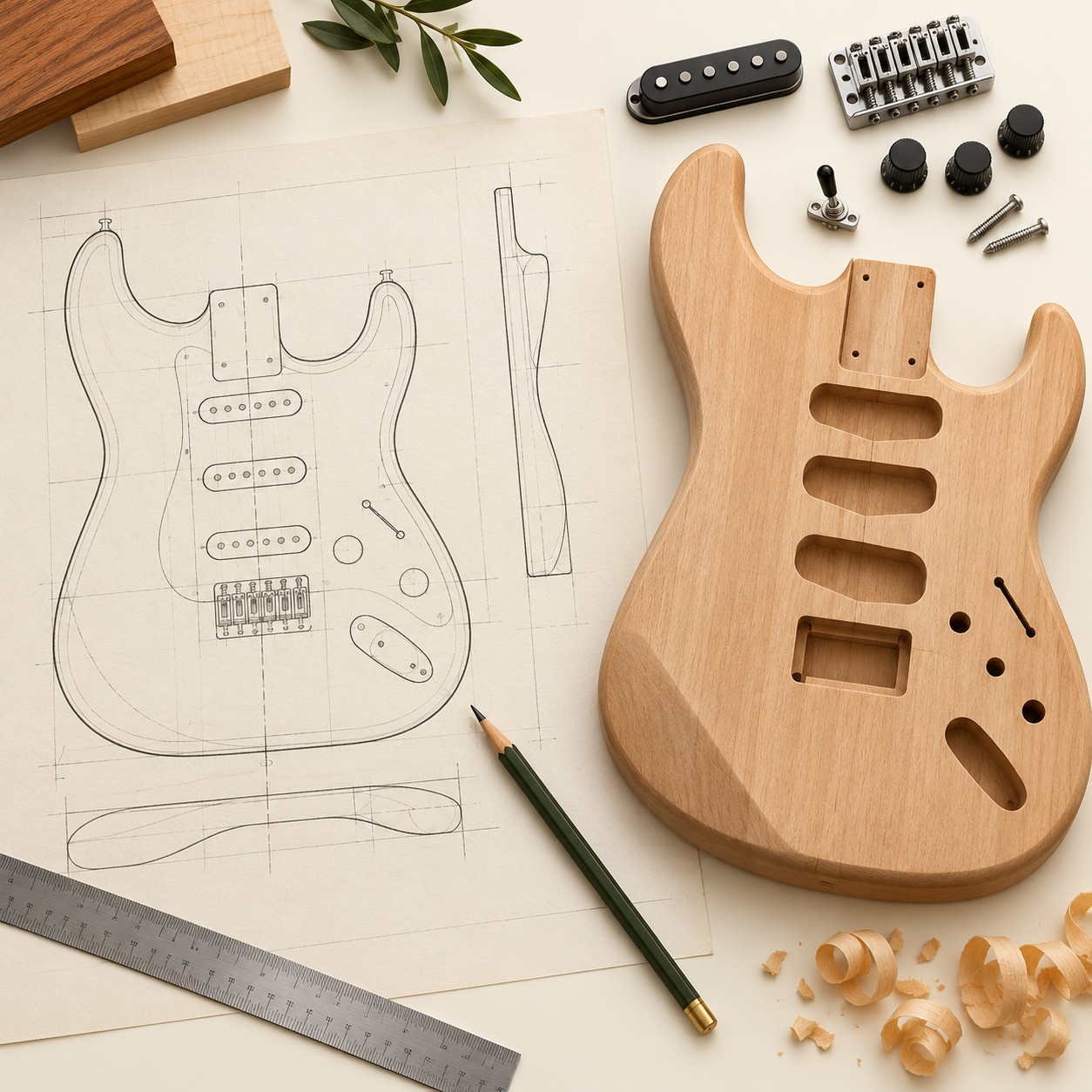
Control artwork for a private-label guitar order
Identify the party responsible for supplying authorized branding and the person who can approve production files. Keep that approval route clear when a designer, buyer, distributor, and supplier are all involved. A forwarded image is not necessarily the approved master. Ask for one controlled source and record who can authorize changes.
WIPO’s trademark guidance explains that protection is territorial. A production supplier’s willingness to apply a mark should therefore not be treated as confirmation that the mark is cleared for every intended market. Use appropriate current professional advice where clearance is needed; this article does not provide a legal opinion about a proposed name or logo.
Define the branding scope
List each item that will carry the brand: instrument, bag or case, hangtag, manual, accessory label, inner package, or outer carton where applicable. Keep optional items separate from the quoted bundle. A logo approval for the instrument should not silently approve every related document and package surface.
State which marks must not appear. If reference samples include another brand, clarify that they illustrate a feature rather than authorize copying that identity. Keep the production design free of unapproved marks. A private-label order should have its own accurate artwork record rather than inherit unrelated branding from a sample photograph.
Supply usable master files
Ask the supplier which file formats and artwork information its actual process requires. Retain editable or vector masters where available, but do not assume that every process uses the same production file. Include the exact spelling and any approved alternative versions. A low-resolution screenshot can be useful for discussion while remaining unsuitable as final production artwork.
Keep fonts, outlines, and linked assets under control according to the designer’s workflow and rights. Do not let a missing font be replaced casually by something similar. Require the supplier to flag an issue before recreating the logo. The goal is to preserve the approved design, not merely reproduce a recognizable approximation.
Specify placement with references
Use a dimensioned placement drawing or another unambiguous reference for each branded surface. State how position is measured and which part of the instrument is the reference. A phrase such as centered on the headstock can be interpreted differently when the surface is asymmetrical or the logo has an uneven visual shape.
Confirm scale and orientation separately. Include the intended relationship to hardware, edges, and other markings. Do not infer final placement from an oblique product photograph. A clear drawing helps the supplier prepare a sample and gives the inspector a practical way to check the approved result.
Agree color and surface appearance
Define the color reference and the way the logo should appear on the actual surface. A screen image cannot guarantee a match on wood, paint, fabric, or corrugated packaging. Ask what the proposed process can reproduce and approve a relevant sample. Keep color, sheen, texture, and contrast as distinct observations where they matter.
If a single-color version or another adaptation is needed, approve it explicitly. Do not let a production limitation become an undocumented design change. Keep the original master and the approved production version together. That makes later reorders easier to reproduce without restarting the discussion from a photograph.
Verify the application method
Ask which branding method is actually proposed and what its limitations are. Placement, edge quality, surface compatibility, and the stage at which it is applied may differ between processes. Do not promise a named printing, engraving, or transfer method unless the supplier has confirmed it for the actual item.
A sample should show the intended method on a representative surface. A paper proof can verify text and layout but cannot establish every physical result on an instrument. Keep those approval stages separate. If durability evidence is required, define the relevant test and claim rather than assuming that a visually attractive sample proves long-term performance.
Build the packaging artwork as a separate project record
Obtain the actual package dimensions or dieline before positioning text and graphics. Confirm which lines indicate cuts, folds, print areas, or another production feature. Do not resize an old layout to fit a new box without checking what changes. The packaging supplier should confirm that the artwork matches the proposed construction.
Separate consumer-facing information from shipping identification. The instrument’s model, variant, and included items need consistent naming, but not every surface has the same purpose. Keep barcodes or other identifiers controlled by the appropriate party. This guide does not establish which labels are legally required in a particular destination; verify current requirements for the actual transaction.
Check words and claims carefully
Proofread names, model codes, contact details, instructions, and pack quantities. Verify any technical or performance statement before printing it. Do not copy another manufacturer’s specifications, certification marks, or service promises into private-label materials. A logo change does not make the underlying claims yours to publish.
Use one approved product data record to populate the instrument tag, manual, carton, and website. Where a field remains unknown, resolve it before production rather than filling it with a plausible value. A consistent mistake across several surfaces is still a mistake; repetition does not strengthen the evidence.
Approve samples in defined stages
First approve the content and layout, then assess the physical result on the actual item where needed. Record what each stage approves and what remains open. A digital proof may settle spelling and position while leaving material, finish, or process quality unapproved. State those limits plainly.
Retain sample identification, photographs, revision, date, and approver. If the supplier makes a correction, request a new controlled proof or appropriate verification. Do not mix a corrected message with an older file and assume production will infer the intended final version. A single approved release reduces that ambiguity.
Control changes and obsolete files
Use clear revision names and maintain an approved release list. Tell the supplier which older files are superseded, and keep the change history for reference. Avoid filenames such as final-final when several versions circulate. The important distinction is the approved revision, not the confidence implied by the filename.
For reorders, confirm that the artwork and product specification remain current. A new component layout, body surface, or packaging dimension may affect placement. Do not assume that the previous logo approval applies unchanged. Review only the relevant changes, but make that review explicit rather than letting a historical sample decide by default.
Inspect the finished order against the release
Check the approved mark, spelling, dimensions, position, color reference, and surface quality using the agreed method. Also verify that the correct packaging revision and bundle contents accompany the instrument. A correct logo on a wrongly labeled carton can still create a serious receiving or sales problem.
Record inspection coverage and any exceptions. If a correction is made, retain evidence of the corrected result and update the relevant item identity. Do not close the issue merely because a new label exists somewhere in the factory. The actual shipped instrument and package must match the approved release.
Define artwork placement against the selected model in the solid-body guitar range. If branded carriers are included, document the corresponding bag and case options separately from the instrument artwork.
Start with a specific inquiry
| Deliverable | Approval reference | Check before release |
|---|---|---|
| Logo master | Authorized file and version | Spelling and design |
| Placement | Dimensioned surface reference | Size and orientation |
| Color | Agreed physical or process reference | Actual surface result |
| Packaging | Correct dieline and revision | Layout and identifiers |
| Claims | Verified product record | No borrowed promises |
| Shipment | Approved release list | Correct item and package combination |
Identify a model in the Gusto Guitar product range and ask which branding and packaging options can currently be supported. Provide the intended scope, authorized artwork, placement needs, and sample expectations. Confirm quantities and timing separately instead of assuming a standard private-label service package.
A well-controlled private-label order leaves a clear trail from master artwork to approved sample and shipped item. It protects the brand’s appearance while making the production task easier to understand. The result is not merely a guitar with a different logo, but a documented identity and packaging system that can be checked and repeated.

Get Best Guitars
Join Gustoguitar.com Newsletter to get more information of electric guitars, classical guitars, and all kinds of guitars.


