

 By Gusto Guitar
Read the construction—not just the f-holes—to understand center blocks, bridge support, amplified response and the evidence worth requesting before purchase.
Semi-hollow vs hollow body guitars should be compared by internal construction, bridge support and performance at the intended volume. That makes the semi-hollow versus hollow-body decision especially easy to misunderstand in an online catalogue. The useful distinction is not how much the guitar resembles a jazz instrument. It is how the body, bridge and internal support are arranged, and how that particular instrument behaves in your playing situation.
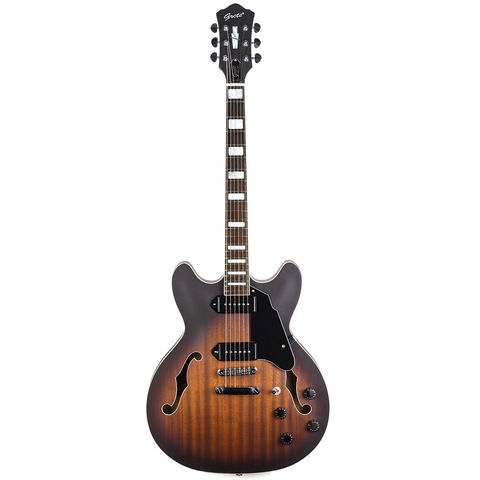
A GT335-04 example from Gusto Guitar’s semi-hollow range. Exterior appearance alone does not establish every internal construction detail.
Compare semi-hollow vs hollow body guitars by construction
Is there a continuous center block?
A familiar semi-hollow arrangement places hollow chambers on either side of a central structural section. The important detail is the extent of that support, not simply whether any wood can be seen through an opening. Ask where the block begins and ends, which components mount to it and whether the supplier can identify it in a construction drawing.
For a documented example, Gibson’s Epiphone ES-335 specification explicitly describes a semi-hollow body with a maple center block. That statement is evidence about that model; it should not be copied onto another guitar merely because both share a double-cutaway silhouette.
How is the bridge supported?
A small support under a bridge is not necessarily the same thing as a continuous center block. Likewise, braces and other internal reinforcements do not automatically make a guitar semi-hollow. Treat the seller’s category name as a starting point and request enough detail to describe the actual arrangement without guessing.
The Gibson ES-330 listing provides a useful contrasting specification: its center-block field is marked “None.” Comparing explicit specifications is more reliable than trying to classify unfamiliar instruments from their outline alone.
What do “solid” and “laminated” refer to?
Those words may describe the top, back, sides or other components. They do not answer whether the completed body has a central block. A laminated construction can still be semi-hollow or hollow. On an enquiry sheet, give each component its own field instead of accepting a single ambiguous phrase such as “solid maple guitar.”
Use this comparison without treating it as a quality ranking
| Decision point | Semi-hollow shortlist | Hollow-body shortlist | Evidence to obtain |
|---|---|---|---|
| Internal structure | Identify the chamber and block arrangement. | Identify bracing and local supports. | An annotated drawing or construction description. |
| Live amplification | Test at your intended rehearsal settings. | Give particular attention to acoustic coupling and stage position. | A controlled demonstration with the actual sample. |
| Physical fit | Check body thickness, contours and balance. | Check the same dimensions rather than assuming a larger body. | Measurements and seated/standing trials. |
| Maintenance | Determine the electronics access route. | Determine the electronics and bridge service requirements. | Access photographs and model-specific instructions. |
Neither column establishes superior craftsmanship. An instrument can be accurately described yet poorly adjusted, or beautifully finished while missing the documentation you need. Assess workmanship separately from the structural category so an attractive label does not become a substitute for inspecting the sample.
What the construction can tell you about amplified use
Yamaha explains that a center block can help control feedback in a semi-hollow design in its guide to electric-guitar body construction. This is a useful tendency, not a promise that every semi-hollow is immune to feedback or every hollow body will be difficult to use.
Separate deliberate sustained feedback from unwanted noise that interrupts a part. A player might value a responsive instrument that can be controlled by position and touch. Another player may need consistent behaviour while moving around a small stage. Those are different requirements, and neither is settled by a quiet showroom chord.
Ask the demonstrator to describe the amplifier, approximate playing level, effects and position relative to the speaker. If these conditions change between clips, record that fact. The comparison then tells you about two demonstrations, not just two body structures. Avoid turning an uncontrolled video into a universal conclusion about which construction can handle a musical genre.
A practical audition for clean playing and ensemble use
First pass: listen to the part you need to play
Choose a short passage containing both chordal and single-note work. Listen for the separation and response you prefer, using the same amplifier channel and a comparable listening level. If one guitar has a markedly different pickup configuration, identify that difference in your notes rather than crediting everything to the chamber layout.
Second pass: check the instrument in a mix
Repeat the passage with the accompaniment you normally use. A sound that is pleasing alone may need different settings in an ensemble. Write down whether the required changes are practical: a small control adjustment during a song is different from rebuilding the entire rig between instruments.
Third pass: evaluate the working position
Test seated reach, standing balance and the position of the picking arm. Check whether the body edge presses uncomfortably after several minutes. The relevant measurement is the fit of the actual instrument, not an assumption that all hollow guitars are large or all semi-hollow guitars are compact.
If the purchase is remote, request a demonstration organized around these three questions. A structured request helps the supplier show information that is otherwise easy to omit, such as the electronics access or a side view of body thickness. Keep the video with the sample specification rather than relying on memory when the production shipment arrives.
Four specification mistakes that create avoidable disputes
Calling every f-hole guitar a hollow body
Sound-hole styling is not a complete internal drawing. Use the manufacturer’s confirmed construction description, and distinguish it from the appearance shown in catalogue images. When the description remains unclear, mark the field unresolved instead of choosing the most convenient label.
Using “jazz guitar” as a construction standard
Musical-use language does not define a center block, top material or bridge arrangement. Ask the supplier which physical characteristics the phrase represents. This is especially important when several products share marketing copy but differ in component specifications.
Assuming a photographed component is the approved component
A familiar pickup cover or tailpiece outline does not establish the manufacturer, specification or revision of that part. Require the order document to identify any component that matters to the decision, and keep approval of substitutions separate from general approval of the guitar’s appearance.
Expecting the unplugged sound to replace an amplified test
Unplugged playing can help you assess the physical experience, but it does not reveal the complete pickup and amplifier response. Decide which use you are buying for. If unamplified practice volume is essential, test that requirement directly rather than treating “hollow” as a guarantee of acoustic-guitar performance.
How a dealer can approve the construction without over-specifying it
Begin with a simple internal diagram showing the relevant support and chamber layout. Add the materials of the top, back and sides, the bridge mounting arrangement and a description of electronics access. You do not need confidential manufacturing instructions to agree on these customer-facing characteristics.
Next, distinguish acceptable appearance variation from structural changes. A wood-grain difference is not the same thing as a different bridge support or an alternative electronic component. Record which changes need renewed approval. This keeps a purchasing conversation focused on functional requirements instead of vague assurances that two versions are “the same quality.”
Finally, retain one approved specification with a revision date and sample identifier. When another shipment is proposed, compare it with that reference. If a discrepancy is discovered, describe the exact field and supporting photograph. A precise query is easier to resolve than a general complaint about a model name.
Frequently asked questions
Does a hollow-body guitar contain no wood inside at all?
Do not interpret the name that literally. Bracing, neck joints and local support details need to be checked on the specific design. The question for classification is how the body is constructed, not whether every interior surface is completely empty.
Is a center block visible through every sound hole?
Do not rely on what happens to be visible in one photograph. The camera angle and body layout may conceal the useful detail. Ask for a construction explanation or a photograph specifically intended to show the relevant support.
Will a hollow body always weigh less?
Request a measured sample weight and check balance. Body size, materials, hardware and construction differ between models, so the category alone is not a dependable weight specification.
Which category should a first-time buyer shortlist?
Choose the instrument that meets the intended use and feels comfortable, then verify the construction and service details. If feedback behaviour is an important concern, make an amplified test a condition of approval instead of guessing from a catalogue label.
Choose from a confirmed specification
The strongest purchasing decision connects three things: a clear structural description, an audition relevant to your playing and a sample that matches the order document. Those checks are more useful than deciding that one category must be more traditional, more professional or better value.
Explore Gusto Guitar’s semi-hollow and jazz electric guitars for current options. For a proposed model, request construction details and a sample specification before confirming the order. Related reading: solid body versus semi-hollow electric guitars.

Get Best Guitars
Join Gustoguitar.com Newsletter to get more information of electric guitars, classical guitars, and all kinds of guitars.


