

 By Gusto Guitar
Choose a jazz guitar by the musical job it must perform: clear chord voicings, controlled amplification, comfortable reach and a response that supports your phrasing.
An electric guitar for jazz should be evaluated through the complete instrument, the playing conditions and the sounds you need to produce. A solo chord-melody player, a small-group accompanist and a guitarist moving between clean and driven fusion parts may need different things. Start with what you must hear and feel during a real performance, then test the instrument against those needs. That approach is more useful than buying a familiar-looking jazz guitar and hoping its appearance guarantees the result.
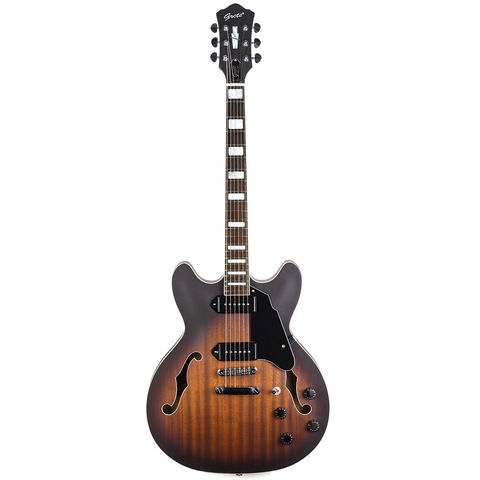
A semi-hollow example from Gusto Guitar. Suitability for a particular jazz setting should be assessed with the actual instrument and amplifier.
Define how an electric guitar for jazz will be used
Before comparing specifications, write down three passages you need the guitar to handle. These might be a melody voiced above chords, a lightly played single-note line and a rhythmic accompaniment behind another soloist. Include the register and dynamics you use. A guitar that makes a low chord sound impressive alone may not make its inner voices easy to follow in a group.
Next, describe the playing environment. Do you practise quietly, record close to a microphone, perform beside drums or work on a small stage with a nearby speaker? Include how much time you spend standing. These conditions determine which compromises matter and prevent a quiet showroom trial from becoming the only evidence for a live-performance purchase.
Finally, decide how much change you are willing to make after purchase. A player who enjoys experimenting with strings and setup may accept a promising starting point. Someone needing an instrument for a scheduled performance should give greater weight to an approved, repeatable setup and readily available service support.
Choose the body for its working behaviour
Hollow-body instruments
If you are attracted to a hollow-body instrument, evaluate its complete amplified response rather than assuming that the construction supplies a particular traditional sound. Check the body depth against your picking-arm position and assess the instrument at the level needed for your music. A construction category does not substitute for those two practical tests.
Semi-hollow instruments
A semi-hollow option may provide a useful compromise for a player who wants that physical format while managing stage conditions. Yamaha’s electric-guitar construction guide explains the role of a center block in helping control feedback. Treat that as a design tendency, not a guarantee that any particular semi-hollow sample is trouble-free at every volume.
Solid-body instruments
Do not exclude a solid-body guitar simply because it looks less traditional. If its clean response, neck feel and control layout support your phrasing, it belongs in the audition. Compare it using the same musical material rather than giving the hollow-looking option a different, more flattering test.
For a detailed explanation of the construction terms, see our solid body versus semi-hollow comparison. The decision here is narrower: which complete instrument lets you perform the jazz parts you actually play?
Listen for note definition before asking for warmth
“Warm” can mean several things: a less pronounced pick attack, less high-frequency content, a particular midrange balance or simply a sound heard at a comfortable level. Explain which quality you want. Otherwise, two people may agree on the word while adjusting the instrument in opposite directions.
Play a chord with a melody note on top and listen to whether that note remains easy to follow. Then move the same idea into a lower register. If the result becomes indistinct, investigate the complete signal chain before rejecting the guitar. The amplifier settings, pickup selection, playing touch and room all belong in the observation.
Reduce treble gradually rather than closing the tone control at the start. You are looking for the point at which the response feels rounded while the important intervals remain understandable. If a particular setting removes the articulation you need, write that down. A darker sound is not automatically a more convincing jazz sound.
Evaluate pickups and controls as a usable system
A neck pickup is a sensible setting to include in the test, but it should not be the only one you try. Listen to the bridge and combined settings where available. Check whether volume changes are manageable and whether the controls can be adjusted during a phrase without disrupting your hand position.
As a documented example, the Ibanez AF95 specification lists two passive Super 58 humbuckers, a three-way selector and separate pickup volume and tone controls. This demonstrates a particular control system; it does not prove that every jazz instrument needs the same arrangement or that a visually similar Gusto model uses those components.
Ask for a switching diagram when a guitar has unfamiliar controls. Test the positions you expect to use, including how they behave when you roll the volume down. Avoid choosing solely by a pickup’s marketing name or assuming a covered unit has a particular internal construction.
Make the string choice part of the audition
Record the exact strings on a demonstration instrument. The AF95 specification cited above, for example, identifies an ECG24 flatwound set and its individual gauges. That is useful documentation because a later test with different strings is not a direct repeat of the original experience.
Try flatwound and roundwound options if both are relevant to your playing, but do not change strings, action and amplifier settings simultaneously and then attribute the entire difference to winding style. Compare one change at a time where practical. Listen for the attack and note separation you need and assess how shifts feel under the fingers.
There is no requirement to use heavy strings to make jazz legitimate. A set should support your technique and intended tuning without making ordinary phrases unnecessarily difficult. If you change gauge, tuning or string construction, have the setup checked appropriately rather than assuming the previous adjustments remain suitable.
A focused audition that reveals useful differences
| Test | What to play or do | What to record |
|---|---|---|
| Chord clarity | Repeat a voicing with an audible melody note in two registers. | Which notes disappear or dominate at the intended settings. |
| Dynamic phrasing | Play one line softly, then with your normal performance attack. | Whether articulation remains controllable across the change. |
| Accompaniment | Comp behind a recording or another musician. | Whether the part occupies the intended space without constant correction. |
| Stage behaviour | Use a suitable rehearsal level and representative speaker position. | Any unwanted feedback and the changes needed to control it. |
| Physical comfort | Play seated and standing for a realistic period. | Arm position, reach and any tension that develops. |
Keep the same basic musical material for each candidate. Match the listening level sensibly, and note any necessary amplifier changes. The aim is not to award points to a famous design. It is to identify which instrument meets your priorities with the fewest inconvenient compromises.
Check the neck through the music you play
Nut width, neck profile and fingerboard radius are useful specifications, but they do not express your entire experience of a neck. Play the chord shapes you use most often, especially any stretches and thumb positions that create difficulty on your current guitar. Include the upper register if your arrangements depend on it.
Listen for uneven notes at your normal touch and check whether the setup supports both melody and accompaniment. Do not judge fretwork solely by how low a seller says the action can go. The useful standard is a stable setup that works with your technique and acceptable noise level.
For a remote purchase, request a demonstration of representative notes and chords rather than a fast solo alone. Ask which tuning and string set were used and retain the sample’s setup record. A clear reference makes a later adjustment discussion much easier.
Plan for rehearsals, transport and service
The instrument must fit your working routine as well as your musical idea. Check the case or bag against the actual body depth, lower bout and headstock arrangement. A generic “electric guitar” label on a bag does not confirm compatibility with a larger or deeper body.
Find out how electronics are accessed and which bridge and tailpiece parts the model uses. If a bridge has a movable base or another arrangement unfamiliar to you, obtain the appropriate restringing and adjustment guidance. Do not improvise a procedure from instructions for a different construction.
Also consider what you need between sets: spare strings, a tuner, suitable tools and an agreed service contact. These practical provisions are less visible than a decorative top but can make a greater difference to whether the guitar is dependable in use.
Resolve disagreements with a second listening pass
If one guitar sounds better alone and another works better with accompaniment, do not average the two impressions immediately. Weight the test according to your actual work. A mostly solo player and a mostly ensemble player can reasonably choose differently from the same shortlist.
Return to the weaker result and determine whether a simple, repeatable adjustment fixes it. If the guitar only works with settings that are impractical for your other material, that limitation belongs in the decision. Keep recordings as references, while recognizing that a recording does not reproduce the complete physical experience.
Common questions about buying a jazz electric guitar
Do I need a hollow body to play jazz?
No body label establishes whether you can play the music. Choose by the sound, response and comfort required for your own material, and test at the intended amplification level.
Should I buy flatwounds before evaluating the guitar?
First document the supplied strings and setup. If you want another set, arrange a comparison and any necessary setup work. Avoid judging an unfamiliar instrument through several undocumented changes at once.
Is a floating pickup always preferable?
It is a design choice to evaluate, not an automatic upgrade. Confirm the mounting arrangement, controls, service access and actual response of the model you are considering.
Start with the available semi-hollow and jazz guitar options. The semi-hollow vs hollow body guide helps identify construction and feedback questions that still need to be checked at the intended playing volume.
Choose the instrument that supports your phrasing
A good decision connects musical examples with physical tests and a confirmed specification. Keep the candidate that lets you hear the voices you intend, control your dynamics and work comfortably in your real environment. Traditional appearance can be part of the preference without replacing that evidence.
Browse Gusto Guitar’s semi-hollow and jazz category, compare the solid-body alternatives and ask for current model details and a relevant demonstration before confirming your choice.

Get Best Guitars
Join Gustoguitar.com Newsletter to get more information of electric guitars, classical guitars, and all kinds of guitars.


