

 By Gusto Guitar
Identify the top, back, sides and internal support separately: laminated panels and solid-wood components are construction choices, not complete quality grades.
A laminated vs solid wood comparison in semi-hollow guitars needs precise layer and construction details before it can support a useful buying decision. The top may be built differently from the back, and the center support is another component again. Understanding those distinctions helps you read a quotation accurately, compare the correct samples and avoid treating plywood as an automatic synonym for poor workmanship or solid wood as a guarantee of a better instrument.
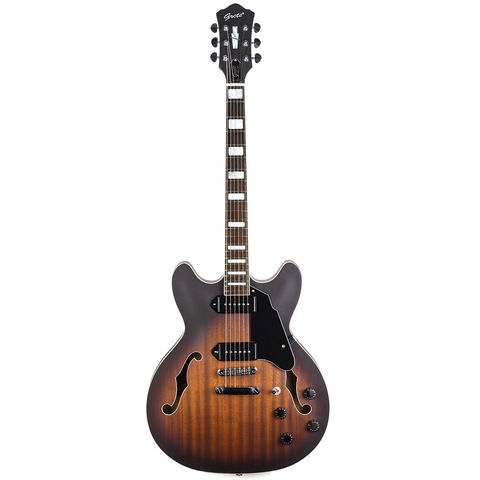
Gusto Guitar GT335-04 reference image. Confirm each panel’s current construction; a finished exterior does not reveal the complete assembly.
Define laminated vs solid wood construction precisely
Solid wood
In a panel description, solid wood contrasts with a panel made from layers of wood through its thickness. It does not necessarily mean the panel came from one uninterrupted board. An edge-joined arrangement and a laminated arrangement answer different construction questions.
Solid body
Solid-body describes a broad body format, rather than proving that every component is one piece of wood. A semi-hollow guitar may contain solid components while still having chambers. Do not translate “solid maple top” into “solid-body guitar.”
Solid support or center block
An internal block can be described independently from the top, back and sides. The presence of that support does not tell you whether the outer panels are layered. Ask where the bridge and other components attach rather than assuming the panel material settles the whole structural description.
What a layered panel description should tell you
A laminated wood panel combines multiple wood layers. A useful specification identifies which panel is being described and, where relevant, the species and order of the layers. A short listing that says only maple may name the visible face without explaining the complete stack.
Gibson provides a documented example in its ES-335 specification, which describes maple/poplar/maple layers. This is evidence that a layered construction is a deliberate choice in that particular instrument. It is not evidence that every guitar with a similar outline uses the same layer count or materials.
Likewise, a named species followed by plywood in a supplier title may still leave the inner layers unclear. Request a more complete description if that detail matters to your order. Do not silently convert a brief marketplace phrase into a precise engineering specification.
What a solid-wood semi-hollow example looks like on paper
Gibson describes the CS-336 Figured Top as constructed with carved and chambered solid woods. That is a different description from a layered-panel assembly, even though both instruments may look broadly familiar from the front.
The point is not that one example wins. It is that the manufacturing description should match the model. Ask whether the proposed top is carved from solid material, formed from layers or made by another stated method. Keep the back and sides as separate questions.
Do not use the word carved by itself to settle material identity. It can describe a visible contour in casual sales language. Request the actual construction statement and a drawing or relevant production-stage photograph if the wording remains ambiguous.
Build a component map before comparing prices
| Component | Question for the supplier | Useful supporting evidence |
|---|---|---|
| Top | Solid, layered or another confirmed assembly? Is a decorative face separate? | A construction description and applicable thickness definition. |
| Back | Does it use the same construction as the top? | A separate material field rather than a general body label. |
| Sides | How are they formed and joined to the rest of the body? | A model-specific assembly explanation. |
| Internal support | Where are the chambers, block and any braces? | An annotated internal diagram. |
| Bridge mounting | What structure supports the hardware? | Mounting details appropriate to the model. |
Use this map for both candidates. It prevents a quotation for one kind of assembly from being compared with another while all differences are attributed to the top’s wood description.
Why the sound cannot be ranked from the panel label
The complete guitar includes its dimensions, internal supports, neck, hardware, pickups, strings and setup. Comparing two instruments that differ in several of those fields does not isolate the effect of solid versus layered panels.
Instead, choose the response you need from the actual sample. Play a clean chord passage, a melodic line and the amplified settings you expect to use. Listen for how the part responds to your touch and fits its musical context, without forcing it to confirm a predetermined hierarchy.
If the supplier claims a specific advantage, ask how it has been demonstrated on the proposed configuration. A personal audition can establish a preference; it should not become an unsupported statement that every layered panel lacks character or every solid panel has superior sustain.
Evaluate unwanted feedback as a separate working test
Panel construction is only part of the instrument’s amplified behaviour. Do not infer a safe stage level from one material term, or assume that a center block makes every sample behave identically. Test the actual instrument in representative conditions.
Use a suitable rehearsal level and document the amplifier, effects and speaker position. Distinguish useful sustained feedback from unwanted ringing that interrupts the part. Record whether practical changes to position or settings solve the issue and whether those changes fit your performance routine.
For remote approval, ask for a structured demonstration rather than an assurance that the guitar is suitable for every genre. A quiet promotional clip cannot answer every stage-use question, regardless of the listed panel material.
Inspect execution rather than judging the word plywood
Check the joints and accessible edges, the finish around openings, the hardware installation and the general playing condition. Where a line or surface feature is unclear, ask the maker to explain it. Avoid diagnosing a structural problem from a low-resolution image alone.
A solid-wood description does not exempt an instrument from these checks. A layered construction does not make workmanship irrelevant. The approval standard should address the completed sample’s condition and the accuracy of its documentation.
Do not scrape the finish or remove parts without an agreed inspection procedure. If internal verification is necessary, request evidence from the supplier or use a qualified person. The aim is reliable identification, not damage caused by an improvised investigation.
Separate structural layers from a decorative veneer
A decorative face and the layers forming the panel are not interchangeable descriptions. An attractive outer pattern may tell you little about the material underneath. Ask whether a figured facing is additional to a layered panel or to a solid component.
For the appearance question, approve the colour, grain and visible transitions. For the construction question, approve the component map and material fields. Keeping those records separate lets you accept natural visual variation without accidentally approving a different internal build.
Related reading: flamed maple tops and veneers. That article addresses the decorative-layer question; this comparison concerns the wider semi-hollow body assembly.
How to read a price difference
Ask which operations, components and appearance options change between quotations. A different construction can involve different manufacturing steps, but the quoted difference may also include pickups, hardware, finish or other specifications. Compare the complete line items before assigning the price gap to one wood term.
For a dealer, tie the choice to the product brief and customer expectations. If the range requires a particular assembly, document it accurately. If both samples meet the playing requirement, cost, appearance, support and repeatability can help settle the decision without a fictitious quality ranking.
Keep later orders consistent
Retain the approved sample identifier, material map, date and any drawings used to clarify the build. Ask for notification before a layer, species or internal support is changed. An unchanged model name is not enough to prove an unchanged assembly.
Make sure the public description matches that record. If only the visible species is confirmed, do not expand it into an all-solid claim. If a layered construction is confirmed, describe it plainly rather than hiding it behind an ambiguous premium adjective.
Keep the layer specification tied to an instrument in the semi-hollow and jazz guitar range. The semi-hollow vs hollow body explanation addresses the separate center-block question, which a laminated or solid-wood label does not answer.
Common specification questions
Does laminated mean low quality?
No. It identifies a construction approach. Evaluate the workmanship, complete design and suitability for the intended use.
Does solid wood mean a one-piece body?
No. Clarify which component and which kind of joint or layering the description concerns. Solid wood and solid-body format are also different terms.
Can I infer construction from the sound holes?
Do not rely on an incidental view alone. Use the manufacturer’s model-specific description and evidence that addresses the relevant component.
Browse Gusto Guitar’s semi-hollow category and request the current top, back, side and support details before approving a proposed model.

Get Best Guitars
Join Gustoguitar.com Newsletter to get more information of electric guitars, classical guitars, and all kinds of guitars.


