

 By Gusto Guitar
Read the bass and treble scales, test the neutral-fret geometry, and check hardware compatibility before choosing a headless multiscale instrument.
Fanned frets describe a fret layout whose practical effect needs to be evaluated alongside the individual string scales, hardware and playing position. Their angled appearance does not make every guitar a low-tuned specialist, and a headless outline does not prove that an instrument uses more than one scale length. The useful questions are less dramatic: what are the endpoint scales, where does the fan become approximately perpendicular, and can you play and maintain this particular instrument comfortably? A buying decision should connect those details to your tuning and playing habits rather than reward the most unusual photograph.
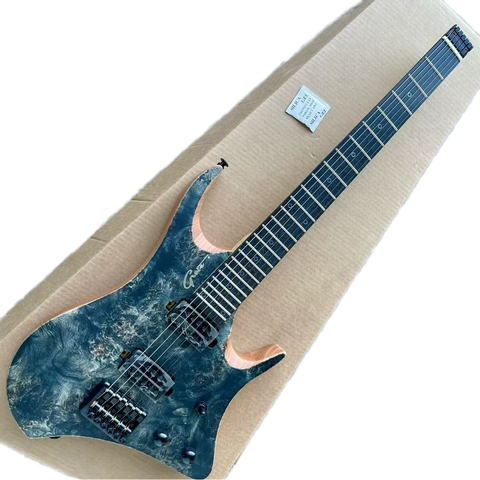
Headless product reference: GTWT-01. Confirm its current scale specification directly; headless construction alone does not establish a multiscale layout.
Read the string-scale geometry behind fanned frets
Headless describes an arrangement in which the conventional tuning headstock is absent. Multiscale describes an instrument designed with different vibrating lengths across its strings. A fanned layout places frets at differing angles to serve those lengths. These ideas can appear together, but they answer different questions. One concerns tuning hardware and packaging; another concerns string geometry.
An official example makes the distinction clear. Strandberg’s string specification page lists different individual scales for its multiscale instruments but identifies the Boden Essential series as a straight 25.5-inch design. That is a brand-specific example of why an outline or brand identity cannot replace the model’s scale table. It does not establish any specification for a Gusto guitar.
Start an enquiry with three independent entries: headless or conventional tuning layout, single or multiple scale lengths, and string count. Add fixed or moving bridge hardware as a fourth entry. A six-string headless instrument may be the relevant candidate even if you have no need for extra-low strings; an extended-range guitar may use a conventional headstock. Keep the selection tied to the job.
What the two endpoint scales tell you
A multiscale specification normally needs at least the shortest treble-side and longest bass-side scale, with the strings identified. “Multiscale, 25.5 inches” leaves too much unresolved. Ask whether 25.5 is the bass endpoint, the treble endpoint or an incomplete description. If the guitar has additional strings, confirm the scale and tuning assigned to the outermost low string rather than assuming a six-string layout was simply widened.
The purpose of unequal lengths is to permit a different balance of string behaviour across the neck. Strandberg’s technical discussion of multiscale guitars explains the design trade-off between longer low-string scales and shorter treble scales, and the importance of the neutral point. That principle does not mean that every player needs the same spread or that a larger spread is automatically better.
For comparison, imagine one proposed design with endpoints 25 and 25.5 inches, and another with 25.5 and 27 inches. These are illustrative dimensions, not Gusto model specifications. Both are multiscale, yet the second changes the geometry much more strongly. Choosing from the word alone hides that difference. Request both endpoints and a clear front-view neck image before arranging a trial.
The neutral fret changes where the angles are most noticeable
The neutral or perpendicular point is the region where a fret lies approximately square to the neck’s longitudinal direction. Its position affects how the visible fan is distributed above and below that region. Two instruments with the same endpoint scales can therefore place different demands on first-position chords or upper-register shapes if their neutral geometry differs.
Do not infer comfort from one slanted fret. Try a first-position chord, a mid-neck barre, an upper-register double-stop and a slide spanning several positions. Watch whether your usual thumb and wrist positions remain comfortable. Test the passage in your normal seated position as well as on a strap: instrument orientation changes the relationship between the hand and the fret angles.
There is no useful promise that everyone adapts within a fixed number of minutes. A player who mainly plays single-note lines may assess the layout differently from someone who holds extended chords. Give yourself enough time to separate unfamiliar visual cues from a repeatable physical difficulty. If one chord remains awkward after slow, accurate trials, that observation belongs in the buying decision.
Evaluate the low and high strings as separate tasks
Low-string response at your actual tuning
Ask for the instrument in the tuning you will use, with the exact string product and gauges recorded. Play short repeated low notes and then a sustained note under a normal picking attack. Listen for an unstable initial pitch, unwanted rattle and the way the note sits in a chord. Those observations are more useful than an isolated claim that the bass side is “tight.”
Compare a fretted passage too. An acceptable open string does not prove that the setup and intonation suit the whole part. Have an appropriately equipped technician assess adjustment concerns rather than choosing a heavier string as a universal cure. The bridge’s available travel and the nut or headpiece’s compatibility are part of the complete setup.
Treble-string bends and chord balance
Use a familiar bend with an audible pitch target and a phrase involving the first three strings. Check whether the high side remains comfortable while the low side provides the resistance you wanted. Then play a chord using both sides of the neck. A layout that works for a low riff can still be a poor match for the same player’s sustained chord work.
Keep amplifier settings consistent when comparing samples. More gain or compression can obscure differences in the attack you are trying to assess. Record both a clean take and your normal performance sound, at matched listening levels, so that a louder or more processed sample does not win automatically.
Headless maintenance needs a model-specific answer
Before ordering replacement strings, confirm which ends the headpiece and bridge accept, how the string is retained, and the usable string length needed for the longest path. Ask for the relevant manufacturer’s instructions and required tool sizes. Do not assume that every headless system needs double-ball strings, or that every system accepts any ordinary set without qualification.
The outer diameter printed on a string packet does not tell you whether every part of its construction will sit correctly in a clamp or saddle. Where a string has a taper or a particular winding termination, its position relative to the hardware matters. A supplier should identify a tested compatible set, rather than merely confirm that the gauge fits through an opening.
For a working instrument, make one supervised string-change trial part of the sample evaluation. Can you access the tuner with your normal hand position? Can the supplied tool reach the retaining hardware without damaging the finish? Are replacement saddles, clamps or other proprietary service parts identifiable? Keep any torque and adjustment procedure strictly tied to the manufacturer’s instructions.
| Question | Evidence to request | Acceptance check |
|---|---|---|
| What is the scale range? | Treble and bass values with string identities | Match the approved specification and sample. |
| Where is the neutral region? | Neck drawing or clear front photograph | Try first-position, mid-neck and upper-register passages. |
| Which strings work? | Exact set, tuning, length and end compatibility | Confirm retention, tuning travel and successful setup. |
| Can it be maintained? | Instructions, tools and service-part identifiers | Demonstrate routine restringing without improvised procedures. |
A sensible trial order for an unfamiliar layout
First confirm the paperwork, then establish tuning and setup, and only then compare playing comfort. This order prevents an unverified scale or unsuitable string set from becoming a judgement about multiscale guitars in general. Keep a familiar instrument available as a reference, but compare specific tasks rather than trying to declare one design universally superior.
If purchasing for a product range, retain a short video showing the actual sample, its model identifier, tuning and the agreed passages. Save the string specification with that video. A later sample with a changed string set can otherwise appear to have changed its geometry or quality when the test conditions have simply shifted.
Identify the instrument in the headless electric guitar range before requesting its individual string scales. The headless guitar buying guide places the fret layout alongside bridge, neck and playing-position decisions.
Three common questions
Does a fan guarantee accurate intonation?
No. Different scale lengths are a design choice, while practical intonation still depends on the actual strings, setup and adjustment. Test fretted notes in the register used by the music rather than treating angled frets as a quality certificate.
Is a headless guitar necessarily a travel guitar?
Check the actual overall dimensions, weight and case fit. Removing a conventional headstock can affect packaging, but the complete body, bridge and protective clearance still determine whether the instrument suits your transport requirement.
Should a first multiscale purchase be a seven-string?
Only if the extra string serves your music. Decide string count and tuning first, then assess scale geometry. Adding an unfamiliar string and an unfamiliar layout together can make it harder to identify which change helps or hinders.
Compare the headless guitar category with the extended-string category, then request confirmed model-specific dimensions and hardware information. A clear sample record is the best starting point for a repeatable choice.

Get Best Guitars
Join Gustoguitar.com Newsletter to get more information of electric guitars, classical guitars, and all kinds of guitars.


