

 By Gusto Guitar
Isolate the signal path before replacing parts or opening the instrument.
A guitar output jack problem should be diagnosed by isolating the signal path before replacing parts or opening the instrument. The symptom does not prove that the output jack must be replaced. A useful troubleshooting process starts with simple, reversible checks and changes one variable at a time. This guide helps players and buyers document the problem and decide when professional assessment is needed. It does not provide a universal rewiring diagram or assume that a particular Gusto model has passive electronics, a battery, or a specific jack design.
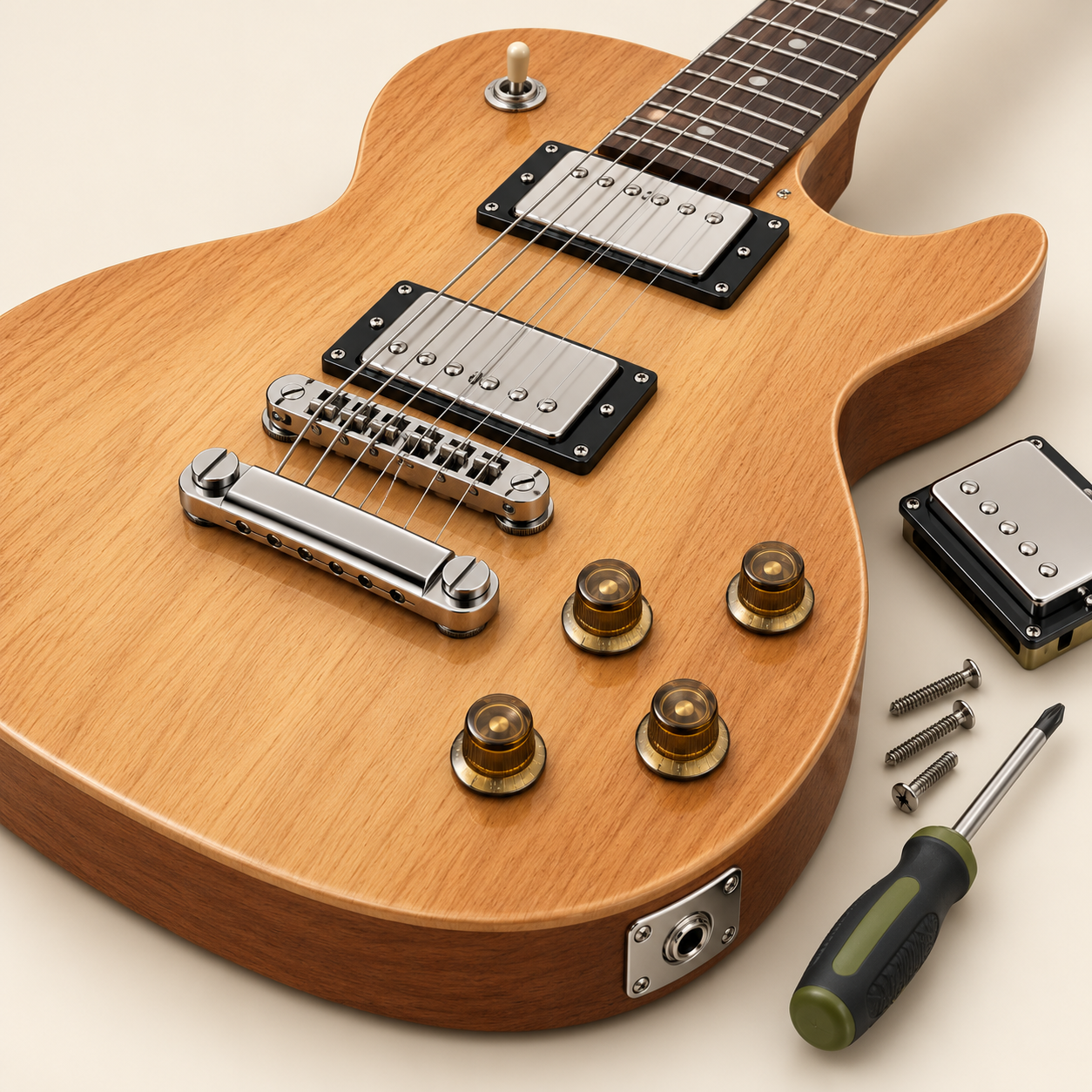
Isolate the signal path before blaming a guitar output jack
Turn the listening level down before connecting or disconnecting equipment, then use a sensible test volume. Confirm the amplifier input and basic controls are set for the intended instrument signal. Check the guitar’s volume and selector position. A silent setting should not be diagnosed as a hardware failure before the normal operating state is established.
Write down the signal chain. Remove optional pedals or other devices from the test where practical, leaving the simplest known-working arrangement. Keep speaker connections and instrument cables in their correct roles according to the equipment instructions. Do not open an amplifier or power supply as part of a guitar-jack investigation; that is a different service task.
Describe the symptom before trying a cure
Is the guitar completely silent, intermittently silent, noisy, or quieter in one position? Does the symptom appear when the cable is moved, when the selector changes, or only with another device connected? Record the behavior in plain language. A precise observation is more useful than saying the jack is broken before the cause has been established.
Seymour Duncan’s intermittent-signal guidance identifies several possible causes involving cables, contacts, and internal connections. Its central value here is that one symptom can have multiple causes. The workflow below uses isolation and documentation rather than treating every crackle as proof of the same fault.
Substitute a known-working instrument cable
Use a cable already confirmed with a functioning setup, not simply a second untested cable from the same drawer. Connect it carefully and repeat the original test. If the symptom disappears, preserve that observation and recheck the first cable under controlled conditions. Do not keep changing amplifier settings at the same time, because that weakens the comparison.
If both cables show the symptom, the guitar is not yet proven faulty. Check the receiving equipment with another known-working instrument if available and appropriate. The purpose is to locate the problem to a smaller part of the chain. A substitution test is strongest when each substituted item is genuinely known to work.
Inspect the accessible connection visually
With the equipment appropriately disconnected, look for obvious damage to the cable plug, jacket, or exposed connection area. Check whether the plug seats normally. Do not force an incompatible or obstructed connection. If a part appears bent, cracked, or loose, record it and seek suitable advice rather than using repeated movement as a stress test.
Do not tighten an external jack nut blindly. Depending on the mounting, the jack body can rotate and strain internal wiring if it is not supported correctly. If you do not know the construction, have a qualified technician assess it. A small visible fastener does not make the complete repair a simple exterior adjustment.
Test positions and controls systematically
With a known signal chain, check each selector position and move the intended volume and tone controls through their normal range. Note whether the symptom affects every position or only some. Use the model’s actual function map; a position that intentionally changes the circuit should not be judged against an assumed generic layout.
A position-specific failure may direct the next assessment toward a different part of the circuit from a failure affecting the whole output. It still does not establish the exact cause without inspection. Record the pattern and provide it to the supplier or technician. This can reduce unnecessary part replacement and make a remote conversation much more productive.
Check power only if the circuit requires it
Some instruments include powered electronics, while others do not. Confirm the actual design before searching for a battery. If a battery is required, follow the maker’s instructions for type, installation, and replacement. Do not infer an active circuit merely because the guitar has several controls or a modern appearance.
If power is relevant, record whether the symptom changes after a correctly performed battery check. Keep that observation separate from the cable test. Avoid repeated random substitutions or opening unfamiliar compartments. A clear sequence lets a technician see what has been ruled out and what still needs assessment.
Use gentle movement to identify a pattern
If the original symptom occurs during normal cable movement, observe it carefully without pulling or levering the plug. Record whether a small change at the guitar end, cable length, or receiving end reproduces the issue. Stop if the connector or mounting appears unstable. The goal is to identify a pattern, not to make the problem worse.
Do not conclude that a jack is good simply because one plug works at one angle. Differences in plug condition and fit can mask a contact issue. Likewise, a noisy cable movement does not prove an internal guitar problem. Keep the substitution results together and avoid choosing the explanation that happens to be most familiar.
Avoid unapproved cleaning shortcuts
Do not spray household cleaners, lubricants, or unverified solvents into the connection. The appropriate treatment depends on the actual component and surrounding materials. If contact cleaning is recommended, use the product and method specified by a competent service source for that part. More liquid is not a reliable way to diagnose an intermittent connection.
Cleaning may also fail to address wear or damaged connections. If a symptom returns, record the history instead of repeating an increasingly aggressive routine. A technician can decide whether cleaning, adjustment, solder work, or replacement is appropriate after identifying the actual condition. Keep the repair decision separate from a first-stage troubleshooting guess.
Know when to hand over the repair
Persistent signal loss, visible damage, an unstable mounting, or uncertain wiring calls for appropriate service. Disconnect the instrument from the test equipment before any internal work. Do not use an unfamiliar generic diagram to reconnect wires simply because their colors seem to match. Component conventions and circuit designs can differ.
If a meter test is proposed, it should be performed by someone who understands what the measurement means in the actual circuit. A reading at the output can reflect more than a pickup alone. Recording a number without circuit context can create false certainty. Ask the service person to identify the fault and document the correction rather than merely report a value.
Prepare a useful supplier report
Include instrument identification, the symptom, the controls or movement involved, known-working substitutions, and a short recording where helpful. State whether the guitar has been modified or repaired. Provide context photographs rather than only an extreme close-up of a connector. Avoid asserting a cause that your checks have not established.
For a new delivery, retain the original as-received observations before making changes. Ask the supplier about the agreed reporting and repair process. This article does not establish Gusto warranty terms or authorize a particular repair route. The current order agreement and supplier response should determine how the case is handled.
Make an intermittent test reproducible
Use a small test log with the cable identity, receiving input, selector position, and action that triggered the symptom. Mark a condition not reproduced rather than declaring the instrument permanently fixed after one quiet attempt. If a technician changes a part, repeat the same logged conditions. This preserves the distinction between an observed improvement and a verified resolution of the reported fault, and gives the next service person a practical starting point if the problem appears again.
Record the exact instrument from the solid-body electric guitar range when requesting service. If the fault concerns a body with different service access, consult the semi-hollow vs hollow body guide before assuming the electronics can be reached in the same way.
Verify the result after service
| Observation | Next isolation check | Avoid |
|---|---|---|
| No output | Controls and known-working signal chain | Assuming a pickup is dead |
| Cable movement causes loss | Known-working cable substitution | Forceful wiggling |
| One position fails | Actual selector function map | Generic wiring assumptions |
| Loose mounting | Qualified supported assessment | Blindly turning the nut |
| After repair | Repeat original and full function tests | Closing on sound alone |
Repeat the original symptom test and the complete control check after the agreed repair. Use the same known-working cable and receiving setup where practical. Confirm that the instrument works through normal handling rather than only while stationary. Keep the repair record and replaced-part identification with the instrument.
When choosing a model from the Gusto Guitar product range, ask for its actual control and connection information. Good documentation helps both initial setup and later service. A measured troubleshooting sequence can turn a frustrating intermittent fault into a clear, actionable report without unnecessary changes to a working circuit.

Get Best Guitars
Join Gustoguitar.com Newsletter to get more information of electric guitars, classical guitars, and all kinds of guitars.


