

 By Gusto Guitar
Agree identification, compatibility, reporting, and remedies before a service problem appears.
Guitar spare parts and after-sales terms should be defined through component identities, compatibility records and an agreed process for reporting problems. A buyer needs to know how the instrument and its components are identified, what information a problem report requires, and how a proposed remedy will be agreed. A general promise of good service leaves those practical questions unanswered. This guide provides an inquiry and recordkeeping framework. It does not establish Gusto Guitar’s warranty, replacement obligations, free-parts policy, repair authorization, or response time; those terms need current written confirmation for the actual order.
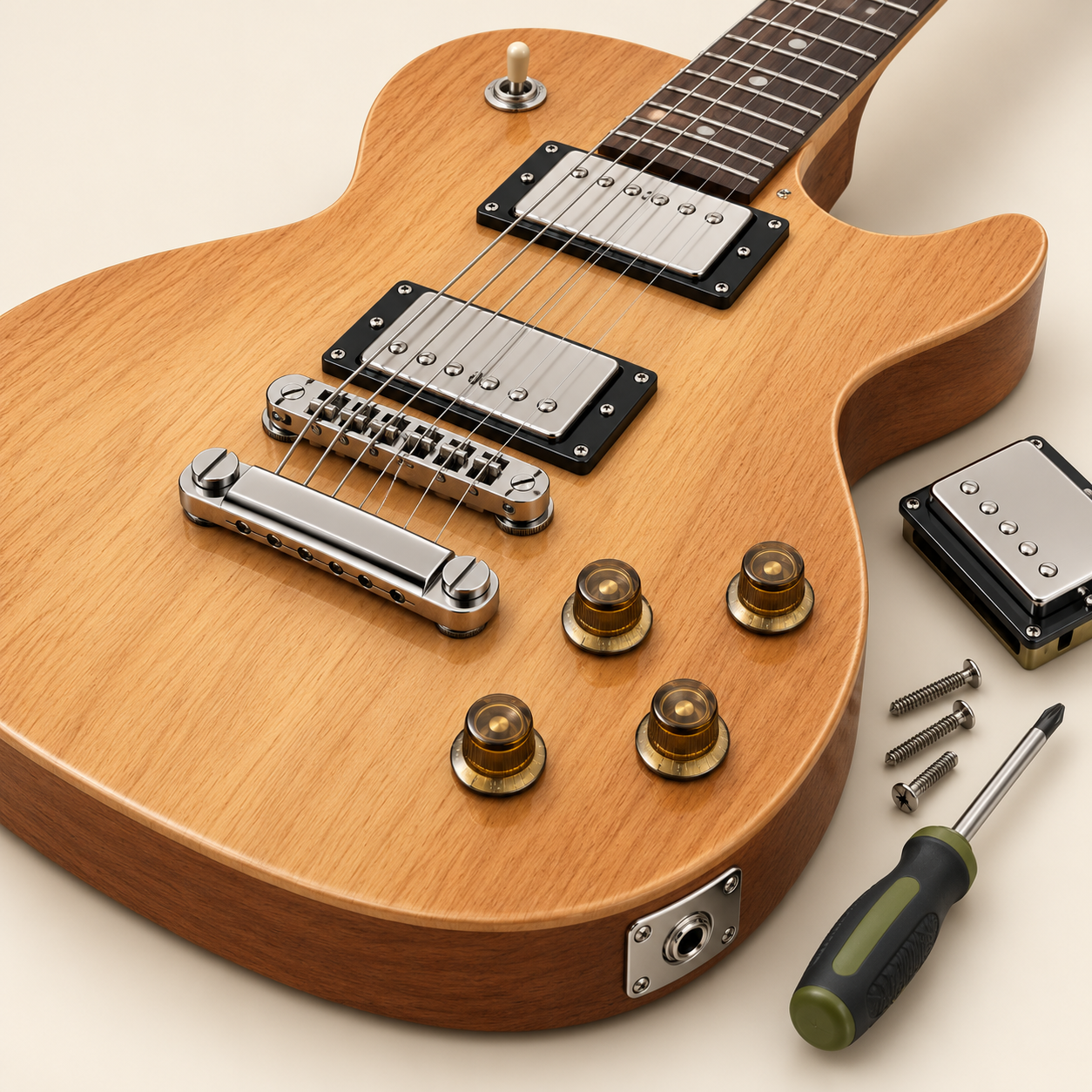
Identify guitar spare parts before support is needed
Keep the model, variant, specification revision, and any available instrument identifier together. Add the order reference and delivery record. For a batch, decide how individual instruments or traceable groups will be identified. A service report should not depend on remembering which of several visually similar guitars a customer bought.
Photographs should include enough context to connect a component to the instrument. A close-up alone may conceal which bridge or control arrangement is present. Keep the original specification even if the model page later changes. This makes a future request about the supplied product rather than whichever version happens to be shown online at that time.
Identify parts more precisely than by appearance
Ask for component references where available and retain dimensions relevant to compatibility. A black tuner, a three-way switch, or a headless saddle is not a complete part description. Similar-looking components can have different mounting, threads, spacing, or electrical arrangements. Do not approve a replacement simply because its photograph resembles the original.
The official EGS Arc guide provides a named example of an illustrated hardware-parts map. The transferable idea is precise identification. Its particular part numbers and service details do not apply to another maker’s guitar, and a similar shape does not establish that the same replacement fits.
Decide which spares are useful
Base a proposed spare list on the actual product range and service needs rather than ordering an arbitrary assortment. Ask which parts are available, how they are identified, and whether they are intended for user replacement or technician installation. Keep consumables, wear parts, and complete assemblies separate in the record.
Confirm quantities, prices, lead times, and any order conditions for the actual spares. Do not assume that a supplier’s ability to source a part today guarantees indefinite availability. If long-term support is important, discuss the relevant arrangement explicitly and retain the response. An inquiry question is not yet a contractual promise.
Define the information needed for a problem report
A useful report states the instrument identity, observed symptom, conditions, and evidence. Ask whether photographs, video, measurements, or an inspection report are needed. Keep the original observation separate from a guessed cause. Saying that output disappears in one selector position is more useful than declaring the pickup defective without testing.
For physical damage, include context images and the delivery or handling history relevant to the concern. Preserve packaging where the agreed process calls for it. Avoid sending unrelated personal information with a technical report. The objective is enough evidence to assess the instrument, not a large unstructured collection of files that obscures the actual issue.
Separate defect, wear, adjustment, and preference
Ask how the supplier distinguishes these categories under the proposed order terms. A player-selected setup change, ordinary wear, a damaged part, and a configuration that differs from the approved specification are different situations. Do not assume that every service request is covered in the same way or that every concern is excluded as normal adjustment.
Keep the agreed definitions and reporting route in writing. If a boundary is unclear, request clarification before the order rather than discovering the disagreement during a customer’s problem. This guide suggests questions to ask; it does not supply legal definitions or replace the current agreement between buyer and seller.
Agree who assesses the issue
Clarify whether the initial assessment is remote, performed by the buyer, or handled by an authorized technician. Ask who can approve further work and what evidence is required before a part is changed. An eager local repair can make a problem harder to verify if the original condition was not recorded or the process required prior approval.
If urgent action is proposed, keep the reason and authorization clear. Do not let an informal suggestion become an assumption that any repair cost will be reimbursed. Confirm the scope, responsible party, and documentation needed. The practical goal is to help the player while preserving an understandable decision record.
Compare remedy options with compatibility in view
Possible agreed responses may include technical advice, a replacement component, local repair, return assessment, or another negotiated arrangement. Ask which options can apply to the actual order. Do not publish them as guaranteed Gusto remedies until confirmed. A useful purchasing brief identifies the process rather than inventing a generous policy.
For any replacement, confirm the part and fit before dispatch. Include necessary instructions and identify whether installation needs a technician. A wrong low-cost component can delay service more than a careful identification step. Retain the original and replacement references so future records show what is now installed in the instrument.
Clarify costs and logistics
Ask how parts, labor, transport, packaging, and any return movement are handled under the proposed terms. Keep these questions separate. An agreement to supply a component does not automatically explain who pays for installation or shipping. Current written terms should identify the scope rather than leave the buyer to infer it.
For cross-border service, discuss the practical documentation and transport requirements with appropriate parties. Do not assume that a returned guitar or spare part follows the same process as the original sale. This article does not provide customs or tax advice; verify current requirements for the actual movement when a case arises.
Retain the original and corrected condition
Before authorized work, preserve the symptom record and relevant measurements. After work, repeat the original test and any related function checks. A repair is not fully documented merely because a new part has been installed. The record should show whether the issue was resolved and what configuration now exists.
If the correction changes the specification, update the instrument record and any relevant customer information. Do not silently keep an old component description after an approved substitution. Accurate service history helps the next technician and prevents a future order from being based on a configuration that is no longer present.
Look for patterns across a wholesale order
Use consistent categories and instrument identities to review repeated concerns. Separate confirmed causes from reported symptoms. Several similar reports can justify a focused investigation, but they do not prove the cause without evidence. Share a concise pattern summary with the supplier and agree what further checks are needed.
Use the findings to improve future specifications, inspection, instructions, or spare planning. Avoid responding only by increasing a random spare quantity. A recurring issue may involve unclear setup guidance, a component choice, packing, or another factor. The correction should address the established cause rather than whichever replacement is easiest to send.
Put support information into the handover
Provide the buyer or player with the actual model instructions, component identification where relevant, approved maintenance guidance, and current contact route. Keep promises consistent with the order terms. A product page should not offer broader service than the business has agreed or can substantiate.
For a private-label range, decide who communicates with the end customer and who communicates with the supplier. Clear responsibility avoids duplicate requests and conflicting advice. Keep the customer’s problem connected to one service record so the final decision and verification can be understood by everyone authorized to handle it.
Keep component records with the instrument in the solid-body guitar range. For tuning parts on a headless model, consult the headless guitar buying guide and request the exact installed system rather than assuming visual similarity proves compatibility.
Ask for current terms before approving the order
| Topic | Ask before ordering | Retain |
|---|---|---|
| Identity | How is each instrument traced? | Model and revision record |
| Spares | Which exact parts are available? | Part references and terms |
| Reporting | What evidence is needed? | Symptom record |
| Authorization | Who approves repair work? | Written scope |
| Costs | Which items and transport are covered? | Current agreement |
| Closure | How is the result verified? | Retest and installed-part record |
Select relevant instruments from the Gusto Guitar product range and request the current parts and support arrangement for that configuration. Include the intended market, service capability, and important replacement needs. Do not transfer another brand’s warranty period or parts promise into the inquiry as an assumed entitlement.
A strong after-sales plan is specific enough to identify the product, report a problem, agree an action, and verify the result. It preserves compatibility and evidence while keeping unconfirmed terms open. That practical clarity is more useful than a broad service slogan that leaves the difficult questions until after delivery.

Get Best Guitars
Join Gustoguitar.com Newsletter to get more information of electric guitars, classical guitars, and all kinds of guitars.


