

 By Gusto Guitar
Understand what thermal treatment means, then verify the neck’s actual construction, finish, fit and setup instead of treating a darker colour as a guarantee of performance.
Roasted maple guitar necks need to be assessed through their actual construction, fretwork, finish and setup rather than their darker appearance alone. Which part is treated maple? What finish is supplied? Is the neck complete and fitted, or a replacement part that still needs work? The useful decision connects the material description with the finished instrument and the support available, rather than assuming every brown-looking neck offers the same properties.
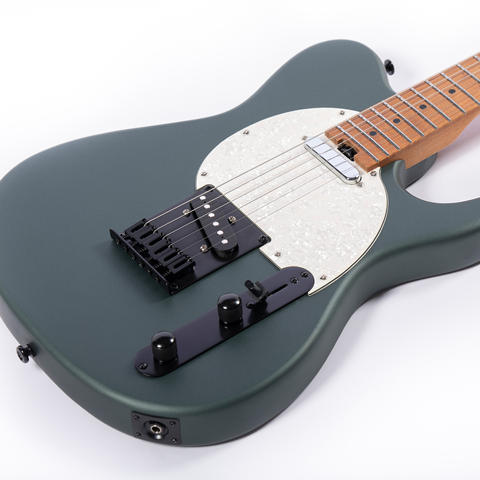
Gusto Guitar GTTL-02 reference image for a complete-guitar enquiry. The photograph alone does not verify thermal treatment; request the current neck specification.
Check the specification of roasted maple guitar necks
In this context, roasted maple refers to maple that has undergone a controlled heat-treatment process. Warmoth’s neck-wood guide describes heat treatment as the basis of its roasted-maple option. That is a material-process description, not a statement about every aspect of the completed neck.
You may also encounter terms such as baked, thermally treated or torrefied. Ask what the supplier means by its term and which component it covers. Do not assume every maker uses an identical process or that a particular treatment schedule can be inferred from the final colour.
There is no reason for a buyer to improvise this process at home. A completed guitar neck includes geometry, joints, hardware and other details that are not a suitable starting point for an improvised heating experiment. The purchasing task is to obtain a correctly made component with a confirmed specification.
Separate treatment from tint, figure and surface finish
A dark surface can result from more than one choice. The material treatment, an applied tint, a clear finish and lighting in the photograph can all affect the appearance you see. A visual match to another roasted neck is not independent proof that the wood received the same treatment.
Likewise, flame or other visible figure is an appearance characteristic to describe separately. If your order requires both roasted maple and a particular figure grade, put both in the brief. One adjective should not silently stand in for the other.
Baum’s explanation of its roasted maple discusses natural variation in the resulting colour. For a purchasing decision, that is a reason to approve a realistic appearance range rather than require every board to reproduce one photograph exactly. It is not a reason to accept an unverified material substitution.
Ask which part of the neck is roasted maple
A neck may have a maple shaft and a separate fingerboard, or a different construction arrangement. A product title can emphasize the shaft material while the selected fingerboard option differs. Read the option-specific specification rather than stopping at the headline.
Record the shaft, fingerboard, any laminations, finish on the back and finish on the playing surface independently. Also record fret material and size, neck profile, nut dimensions and adjustment access. Thermal treatment does not determine those other fields.
This separation prevents a common comparison error: attributing a preferred feel to roasting when the two samples also have different profiles, fret sizes or surface finishes. You can prefer one sample without claiming you have isolated the reason for that preference.
Interpret stability claims with an appropriate limit
Manufacturers often present roasted maple as an option intended to improve behaviour through environmental changes. Fender, for example, describes humidity resistance on its roasted maple replacement-neck listing. Treat that as the manufacturer’s description of its product, not a universal promise that another neck never moves or needs adjustment.
A guitar remains a complete system with strings, hardware, fretwork and a setup. If tuning changes, the cause should be assessed rather than immediately credited to or blamed on the neck material. A thermal-treatment label is not a diagnosis of every tuning or playability problem.
Ask what care and environmental guidance applies to the exact instrument. Keep ordinary storage and handling sensible, and do not remove those precautions because a sales description uses the word stable. Where stability is central to a bulk purchase, agree on a meaningful evaluation procedure with the supplier instead of inventing an unsupported guarantee.
Confirm the finish requirement with the maker
“Roasted” does not answer whether the neck is supplied bare, oiled, satin-finished or gloss-finished. Each choice affects the surface the hand contacts and the maintenance instructions. Request the actual finish specification, including the fingerboard and headstock where relevant.
Warmoth’s own warranty guidance includes roasted maple among its neck woods that do not require a hard finish. That is a maker-specific policy. It should not be copied into a warranty statement for a different supplier’s part.
Fender’s replacement-neck example lists its finish arrangements separately from the roasted-maple description. This illustrates why a buyer should ask both questions. Do not apply a cleaning product or additional finish solely because it was recommended for someone else’s roasted neck.
A neck enquiry sheet that avoids missing details
| Field | What to request | Why it matters |
|---|---|---|
| Material and treatment | Confirmed shaft material and the supplier’s treatment description. | Distinguishes an actual specification from colour alone. |
| Fingerboard | Material, radius, frets and any separate surface finish. | Defines the playing surface independently of the shaft. |
| Fit | Scale, heel dimensions, mounting and tuner compatibility. | A material label does not establish replacement compatibility. |
| Supplied condition | Nut completion, fretwork, holes and required installation tasks. | Separates a component from a ready-to-play installation. |
| Care and support | Maker-specific finish, adjustment and warranty instructions. | Avoids transferring another brand’s rules to this neck. |
For a replacement neck, verify fit before modifying anything
A replacement neck is a compatibility project as well as a material choice. Check the intended scale, heel geometry, mounting arrangement and hardware dimensions against the body. A familiar model-style name is not enough to confirm that all replacement parts interchange.
Read what work remains on the supplied nut and frets. Fender’s cited listing explains that its replacement neck may require final nut work, fitting and setup by qualified personnel. That is a useful reminder to budget installation rather than treating a loose neck as a finished playing instrument.
Inspect the part and resolve discrepancies before drilling, filing or otherwise altering it. Use the supplier’s installation instructions or a qualified technician. Do not force hardware into place or assume a procedure intended for a different neck construction is suitable.
For a complete guitar, audition the actual feel
Play ordinary first-position chords, a phrase higher on the neck and any bends or stretches important to your music. Notice whether the profile suits your hand and whether the back finish feels comfortable through a realistic session. A preference for satin over gloss is not automatically a preference for treated over untreated wood.
Check the instrument at your intended tuning and with its string set recorded. Ask for the agreed setup if action or relief appears unsuitable. The goal is a playable complete guitar, not a material that compensates for unresolved fret or setup work.
If comparing two instruments for sound, document the other differences. Pickups, strings, bridge, dimensions and settings may all differ. A better sustained note in one demonstration does not isolate roasting as its cause, and it should not become a guaranteed tonal promise in your catalogue.
Approve appearance and function through different records
For a production order, keep the colour or figure reference separate from the functional inspection. Photograph representative samples under comparable lighting, but record dimensions and playing checks as their own evidence. A visually darker batch is not automatically a functionally better batch.
If a later sample changes colour, ask whether the treatment, finish or only the natural board appearance differs. If it changes specification, follow the agreed substitution process. This gives a supplier a precise question to answer rather than an accusation based only on screen colour.
Questions that prevent unrealistic expectations
Does roasted maple never need adjustment?
No such universal guarantee should be inferred. Follow the exact instrument’s instructions and evaluate any changes in the complete setup.
Is a darker neck always more heavily treated or better?
Do not use colour as a performance grade. Confirm the material and process description, and approve acceptable appearance variation separately.
Can I use another maker’s no-finish policy?
Use the policy and care instructions of the supplier responsible for your neck. Similar material wording does not transfer warranty conditions between brands.
Check the neck on a complete model from the solid-body range. For an instrument with a different tuning arrangement, the headless guitar buying guide keeps neck evaluation connected to hardware, balance and maintenance access.
Buy the specified neck, not the adjective
Roasted maple can be part of a well-defined guitar brief. Its value is easier to judge when you know the actual shaft and fingerboard materials, surface finish, fit, required work and support. Give those fields the same attention as the visual appeal.
Explore Gusto Guitar’s solid-body range and request the current neck construction and finish details for your proposed model. An existing photograph or older listing should not replace confirmation of the configuration being quoted.

Get Best Guitars
Join Gustoguitar.com Newsletter to get more information of electric guitars, classical guitars, and all kinds of guitars.


