

 By Gusto Guitar
Resolve disagreements with a controlled evidence record rather than choosing the most attractive version.
Conflicting guitar specifications should be resolved through targeted evidence and a controlled revision, rather than choosing the most attractive listing claim. The conflict may reflect an outdated page, a variant mix-up, a translation issue, or a real change in the product. It should not be resolved by selecting whichever version sounds best. A useful verification process preserves the conflicting statements, identifies the exact model, and asks for evidence that answers the specific question. This guide explains that process without accusing a supplier of deception or treating a plausible correction as a verified fact.
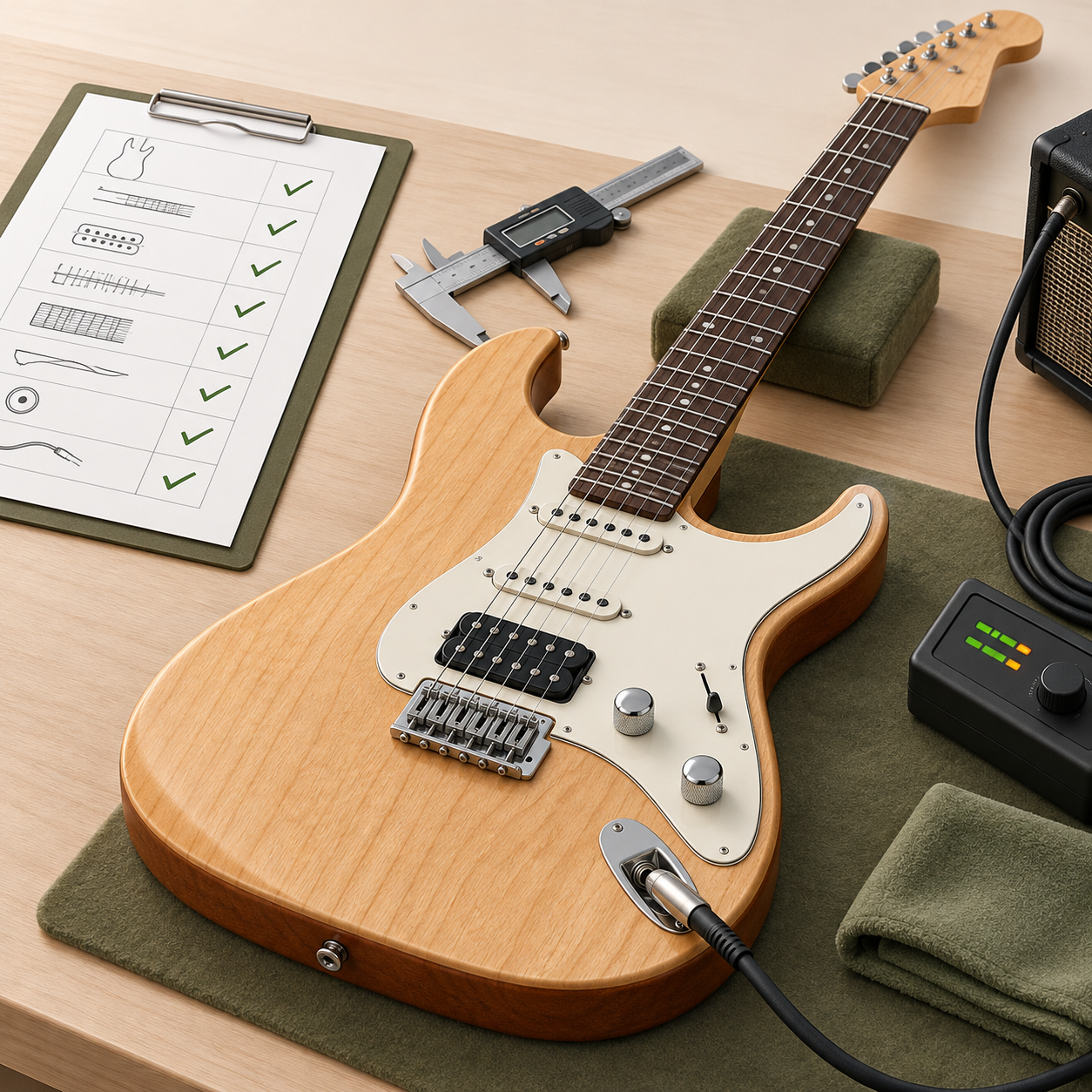
Record conflicts in guitar specifications before approval
Record the exact statements, their locations, dates where available, and the model or variant they appear to describe. Keep a copy of the relevant text and images for the task record. If the page changes during the inquiry, the original discrepancy should remain understandable. Do not overwrite the only evidence before asking what it means.
Separate a factual conflict from a wording preference. Two phrases may describe the same feature at different levels of detail, while two similar-looking numbers may refer to different measurement methods. State the question neutrally. A concise record such as title says one value and table says another invites a more useful answer than a broad claim that the whole catalog is unreliable.
Confirm product identity first
Check model code, variant, string count, handedness, finish, and any revision information. A photograph may show one option while a table describes the family. Ask whether the source concerns the exact instrument being quoted. Until identity is settled, comparing individual fields can create false conflicts between legitimately different products.
Keep electric guitars and basses distinct. A listing that mixes terminology needs clarification rather than an assumption that a string count proves the product type. Ask for a current model-specific record and relevant photographs. Do not use an unrelated product with a similar name to fill the gaps.
Classify the question by evidence type
Some claims can be checked directly on the completed instrument, such as string count or the visible control layout. Others need a measurement, a functional demonstration, or production documentation. Hidden materials and internal component identity should not be marked visually verified because the exterior looks consistent with the claim.
Choose evidence that can actually resolve the disagreement. A new beauty photograph may not answer a scale-length question. A generic drawing may not establish the construction of the quoted revision. Ask what the evidence identifies and how it is linked to the actual model. This keeps the inquiry focused and reduces repeated exchanges of impressive but irrelevant material.
Resolve numerical conflicts through definitions and units
For a dimension, ask what was measured, between which points, in which units, and by which method. Preserve the original value before converting it. A rounded inch description and a millimeter specification may need explanation rather than automatic replacement. Do not silently correct a number because it resembles a familiar industry’s nominal size.
A hypothetical listing might show one scale figure in its title and another in its table. Ask for the actual model’s controlled specification and a measurement reference if necessary. The goal is not to choose the more familiar number, but to establish which value belongs to the instrument. Record the supplier’s correction and the evidence that supports it.
Resolve pickup terminology through structure and function
A phrase combining pickup names can be ambiguous. Ask whether it describes physical size, internal construction, a cover style, or a switching function. A photograph may show the outer shape while leaving the coils and magnet unknown. Do not label the product definitively from the cover alone.
Request a component identification and function map where relevant. If a listing says a switch provides a split function, ask what each position actually does. Keep the answer separate from a generic circuit diagram until the supplier confirms the match. A familiar name is a useful question prompt, not proof of the supplied design.
Resolve wood and layer descriptions separately
Ask which part uses each named material: main body, top, decorative layer, neck, or fingerboard. A maple neck statement does not establish a maple body. A visible figured surface does not establish layer thickness. Keep the material declaration tied to the exact construction rather than merging several fields into one broad guitar description.
If an exact species or concealed layer matters, request appropriate documentation or an agreed production reference. Do not conduct destructive testing on a saleable sample merely to settle a catalog inconsistency. Use a suitable specialist assessment if the requirement calls for it, and describe the remaining uncertainty honestly.
Distinguish current terms from historical listings
A previous price, quantity, or lead-time statement may no longer describe the current offer. Ask for a dated quotation for the actual configuration and quantity. Do not present an old figure as a live promise simply because it remains indexed online. Keep technical verification and current commercial confirmation as related but separate tasks.
The International Trade Administration’s quotation guidance describes an invoice-format offer containing order and delivery details. For this workflow, use the current written offer alongside the controlled technical sheet. A corrected product page alone may not resolve an order document that still contains the conflicting value.
Ask one clear question per unresolved field
Create a short list that shows the conflicting versions, the requested confirmation, and the evidence needed. Avoid combining several different questions into a vague request to confirm everything. A supplier can then reply point by point and identify which items are corrected, confirmed, or still under review.
Keep the tone factual and allow for an honest explanation. A good response may acknowledge that an image is illustrative or that a table was copied from an older revision. That explanation still needs a corrected model record. The objective is an accurate purchasing basis, not winning an argument about which source looked more authoritative.
Build one approved specification release
Once the questions are resolved, consolidate the agreed values in a dated revision. Keep the evidence and approval with it. State which older records are superseded and which variants the release covers. Do not let the title, body text, table, SEO description, and quotation continue to tell different stories after the inquiry is closed.
For an existing order, assess whether the correction changes what was approved. A change in a material requirement or function may need explicit agreement rather than a quiet content edit. Keep the original and revised records so the decision remains traceable. This is a proposed document-control practice, not a blanket legal conclusion about the transaction.
Verify the sample against the release
Use direct checks, measurements, functional tests, and documentation according to the field being verified. Record the sample identity and inspection conditions. If a field remains unsupported, keep it open. A sample that performs well does not automatically prove every hidden specification printed in its listing.
If a new discrepancy appears, add it to the same controlled inquiry rather than creating an unconnected correction in another file. This prevents a chain of partial truths spread across messages. The approved record should remain the place where a buyer can see both the current specification and the basis for accepting it.
Use precise evidence status
Mark an item confirmed, contradicted, or unresolved according to the available evidence. Unresolved does not mean false, and a supplier reply does not automatically mean independently measured. Record who made the statement and what supports it. If a deadline requires a decision before verification is complete, identify the remaining risk explicitly rather than changing the status to make the sheet look finished. This gives the next buyer or editor a clear reason to revisit the field and avoids converting an open question into an established product fact.
Cross-check the model identity in the solid-body guitar range before resolving a disputed specification. For a guitar described as semi-hollow, use the semi-hollow vs hollow body explanation to frame a precise construction question.
Publish only the supported result
| Conflict | Evidence to request | Avoid |
|---|---|---|
| Title versus table | Exact model revision | Picking the better-sounding version |
| Dimension mismatch | Definition, units, measurement reference | Silent correction |
| Pickup wording | Component and function map | Cover-shape inference |
| Wood wording | Part and layer declaration | Photo as species proof |
| Old commercial figure | Current dated offer | Historic price as promise |
| After resolution | Controlled approved release | Leaving old SEO values |
Update product content from the approved release and check for old values in titles, tables, captions, image alt text, SEO fields, and linked documents. Do not strengthen the wording during rewriting. A broad material statement should not become an exact species claim simply because more specific wording seems better for search.
Use the Gusto Guitar product range to identify the actual model and keep unresolved questions visible until answered. Verification is complete when the current claim, relevant evidence, and approved product identity agree. Repeating the preferred value across several pages without that link is consistency of wording, not proof.

Get Best Guitars
Join Gustoguitar.com Newsletter to get more information of electric guitars, classical guitars, and all kinds of guitars.


